

TL;DR
- IRB = Institutional Review Board, the committee responsible for approving human-subjects research before it starts.
- IRB approval means your study has been formally cleared as ethical, safe, and compliant with federal regulations.
- There are three review types: Exempt, Expedited, and Full Board — each with a different timeline.
- Approval can take anywhere from a few days to 8+ weeks, depending on review type and how complete your submission is.
- You'll need a protocol, consent forms, recruitment materials, and (usually) CITI training documentation before you apply.
IRB stands for Institutional Review Board — a committee that reviews research involving human subjects to catch ethical risks before a study begins, covering informed consent, participant safety, and privacy protections. IRBs exist because of past research abuses and are legally required at nearly every U.S. research institution today.
"Exempt," "expedited," "full board" — IRB paperwork uses these terms without explaining what each one means for your timeline. This guide breaks down what IRB approval involves, what documents you need before submitting, how long the process realistically takes, and what tends to slow it down. Whether you're a grad student filing your first protocol or a PI running a multi-site study, you'll find the specifics here with no jargon and no guesswork.
IRB Meaning: What Is It?
The acronym breaks down simply, but what it does is the part that matters. In short, the meaning of IRB comes down to oversight. An IRB is a formally established committee that reviews research studies before they involve human participants. The board exists to protect study participants from unnecessary risk and confirm they understand the terms of their consent.
Every IRB operates under federal regulations, primarily 45 CFR 46, set by HHS, and, for FDA-regulated research, 21 CFR 50 and 56. These rules apply regardless of funding source in most cases — university-run studies, hospital trials, even some student research projects all fall under IRB oversight.
An IRB typically includes a mix of scientists, non-scientists, and at least one community member unaffiliated with the institution. This mix exists on purpose. It keeps the review from being a purely internal, self-interested process, and brings in perspectives outside the research team's own field.
"IRB" is used two ways in conversation. Sometimes it refers to the committee itself ("submit it to the IRB"). Sometimes it refers to the process ("waiting on IRB"). Both are correct — context makes the meaning clear.
Origin of IRBs
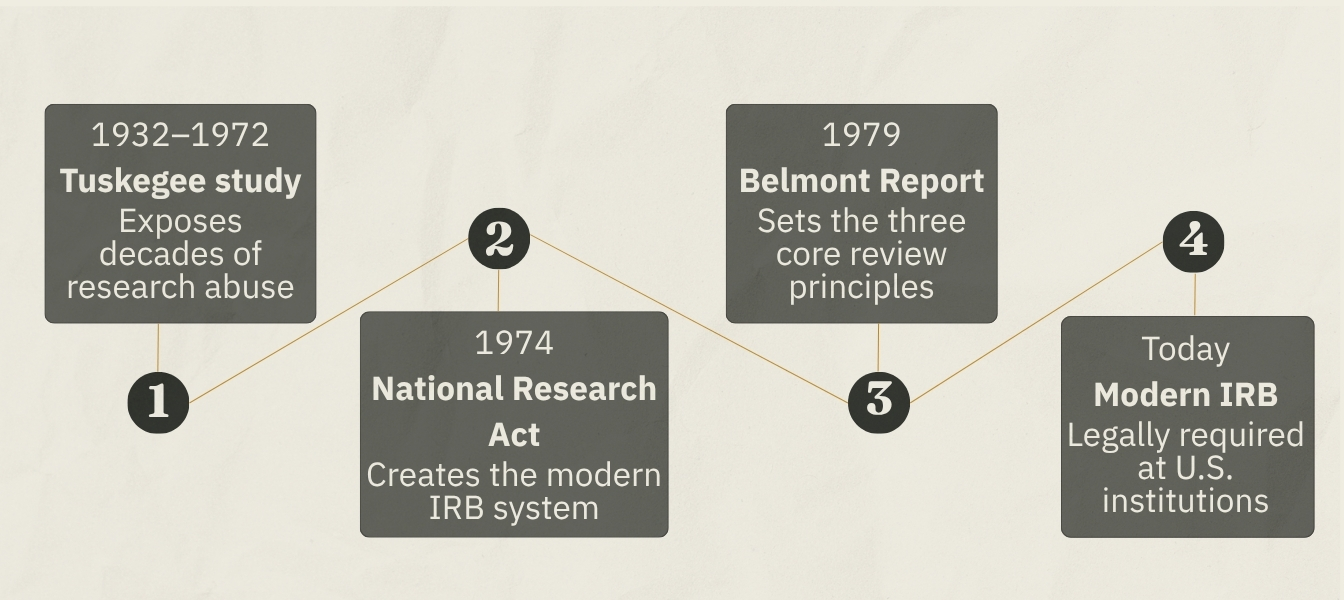
IRBs exist because of past research abuses. The most cited case is the Tuskegee Syphilis Study, where researchers withheld treatment from Black men for decades without their consent. Public outrage led to the National Research Act of 1974, which created the modern IRB system.
That same act produced the Belmont Report in 1979. It laid out three core principles: respect for persons, beneficence, and justice. These principles still shape every IRB review today, whether the study is a clinical trial or a short online survey.
IRB vs. Ethics Committee (IEC)
Outside the U.S., the same function is usually called an Ethics Committee (EC) or Independent Ethics Committee (IEC). The terms aren't identical by law, but they serve the same purpose: reviewing research for ethical and safety compliance before it proceeds.
If you're submitting research internationally or publishing in a journal with global reviewers, expect "IRB" and "IEC" to be used interchangeably. Some journals even list both terms in their submission guidelines, so don't be thrown off if a form asks for "IRB/IEC approval" — they're asking for the same thing.
Approval from either body isn't always the end of the process — boards can still send a study back for revisions after this initial review.
What Is IRB Approval?
The IRB approval meaning is simple: a study has been formally cleared to begin. It confirms the study is safe, ethical, and compliant. It says nothing about the quality of the research question. Approval is tied to the exact materials submitted. Any changes after that need a separate review. Most approvals last 12 months. After that, the study needs continuing review to stay active.
What an IRB Actually Reviews
An IRB doesn't evaluate your hypothesis. It doesn't judge your methodology either. Its focus stays on five specific areas:
| Review Area | What the IRB Is Checking |
|---|---|
| Risk vs. benefit | Whether potential harm is reasonable given the study's value |
| Informed consent | Whether participants clearly understand what they're agreeing to |
| Data privacy | How data is stored, who can access it, and for how long |
| Vulnerable populations | Extra safeguards for minors, prisoners, or limited-capacity participants |
| Recruitment materials | Whether ads or flyers describe the study accurately, without pressure |
Types of IRB Review
Review type depends on risk. Not subject matter. Not importance.
Exempt review covers minimal-risk studies that fall into specific federal categories. IRB staff usually handle this, often within days. Expedited review applies to studies with no more than minimal risk that don't qualify for exemption. The IRB chair reviews these alone. Full board review is for higher-risk studies, or those involving vulnerable populations. These require a convened meeting of the full committee.
OHRP publishes the exact boundaries for each category in the Federal Register. If your study sits close to one, it's worth checking the source directly.
What Are IRB Requirements?
Most IRB applications ask for the same core set of materials. What changes is the depth required, not the list itself. A minimal-risk survey needs far less detail than a clinical trial. But the basic checklist rarely changes across fields.
Missing documents are the most common reason applications stall. Not flawed research. Not a bad topic. Just an incomplete file. Knowing what's expected before you submit saves an entire review cycle. Most institutions also require any team member handling data to complete the same training, not just the lead researcher. That detail gets missed often, and it's an easy one to fix early.
Document Checklist
A typical IRB application requires the following:
- Research protocol — your study design, procedures, and timeline. If you've written a research proposal, most of this carries over directly.
- Informed consent form — covers purpose, risks, benefits, and voluntary participation
- Recruitment materials — flyers, emails, or scripts, checked for accuracy and tone
- CITI training certificate — for every team member handling data
- Data management plan — how data is stored, secured, and eventually destroyed
- Investigator CV or biosketch — especially for funded or higher-risk studies
- Site permission letters — if collecting data outside your home institution
- IRB application form — the cover form tying everything together
Common Requirements by Study Type
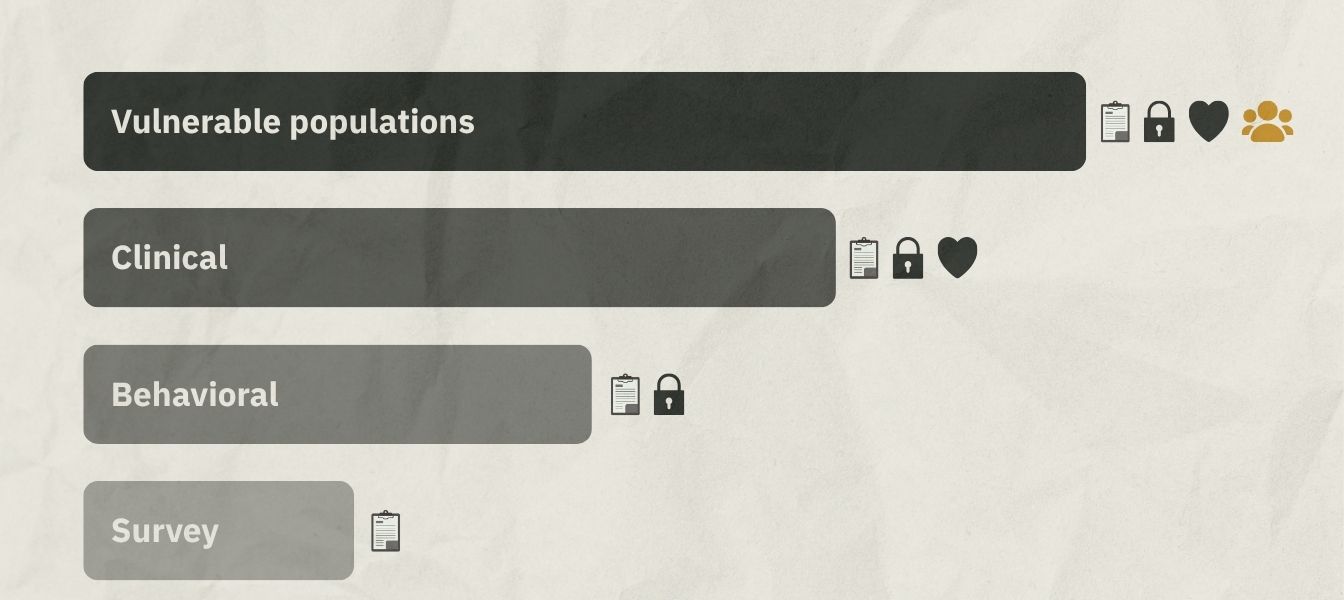
The topic doesn't decide how much oversight a study needs — the actual risk to participants does.
Requirements scale with risk, not field. A short, anonymous survey usually only needs a protocol, consent language, and recruitment materials. Nothing more elaborate than that.
A behavioral study involving interviews or focus groups adds a heavier layer. Consent needs more detail, since participants are identifiable. A data security plan becomes necessary too, especially if recordings or transcripts are involved.
Clinical or biomedical research carries the heaviest load. Safety monitoring plans, detailed risk disclosures, and often a data safety monitoring board are expected. Adverse event reporting procedures are usually required as well.
Studies involving vulnerable populations require extra documentation, regardless of field. This usually means added consent steps, like parental permission for minors or a prisoner representative where applicable. Those extra steps exist because the population itself carries more risk, not because the topic is more sensitive to review.
How Long Does IRB Approval Take?
Timelines vary by review type and institution. Exempt studies often clear in a few days to two weeks. Expedited review typically takes two to four weeks. Full board review takes the longest, often four to eight weeks, since it depends on when the committee meets.
Incomplete submissions add time on top of any of these ranges. So does a high volume of applications at your institution during peak semester periods. Building in buffer time before your planned start date is worth doing regardless of which track your study falls under.
Timeline by Review Type
| Review Type | Typical Timeline | What Affects It |
|---|---|---|
| Exempt | A few days to 2 weeks | Staff availability, completeness of submission |
| Expedited | 2 to 4 weeks | Chair's schedule, complexity of the protocol |
| Full Board | 4 to 8 weeks | Committee meeting dates, revision rounds |
These ranges reflect a first, clean submission. If your study comes back with revisions, that adds another cycle on top — we cover how minor versus substantive revisions are handled differently in a separate guide.
What Slows Down Approval
Incomplete submissions cause the most delays by far. A missing signature, an outdated CITI certificate, or a consent form that doesn't match the protocol all send an application back before review even starts.
Vague or inconsistent language is another common cause. If the protocol describes one procedure and the consent form describes something slightly different, reviewers have to stop and ask for clarification. That single question can add a week or more, depending on the committee's meeting schedule.
Most IRBs see a spike at the start of each semester or grant cycle. Submitting during a quieter period, when possible, often means a faster first response.
Studies involving vulnerable populations or higher risk levels also take longer by design. More reviewers need to weigh in, and more safeguards need to be verified before approval.
How to Speed Up Your Submission
Most delays aren't caused by the review itself — they're caused by avoidable mistakes before and after submission.
Start by reading your institution's checklist before writing anything — every IRB publishes its own formatting and content requirements, and skipping this is the single most avoidable cause of delay. Your consent form and protocol should match exactly too, since reviewers cross-check them line by line, and even a small mismatch usually triggers a revision request.
Missing a committee's cutoff date by a single day can push a full board review back an entire month.
A second pair of eyes helps too — a colleague or advisor often catches inconsistencies you've read past too many times to notice yourself. And once revisions are requested, respond quickly: most post-submission delays come from slow turnaround, not from the fixes themselves.
FAQ
Is IRB approval the same as ethics approval?
Yes, in practice. "Ethics approval" is the term used more often outside the U.S. and in some journals, while "IRB approval" is the U.S. regulatory term. Both refer to the same review process.
Can IRB approval be denied?
Yes, though outright denial is rare. Most issues get resolved through a revision request instead. Denial usually happens when a risk or consent issue can't be fixed within the study's design.
Do all studies need full board review?
No. Most studies qualify for exempt or expedited review, which move faster. Full board review is reserved for higher-risk studies or those involving vulnerable populations.
Who actually sits on an IRB?
IRB members typically include scientists, non-scientists, and at least one community member unaffiliated with the institution. This mix is a federal requirement, meant to prevent purely internal review.
Does IRB approval expire?
Yes, in most cases. Approval is usually valid for 12 months. After that, the study needs continuing review to stay active, even if data collection isn't finished.
Final Thoughts
IRB approval isn't a judgment on your research question. It's a check on safety, consent, and compliance, nothing more. Understanding what IRB means, what it reviews, and how long the process takes removes most of the anxiety around submission. The requirements are consistent once you know them, and the timeline is predictable once you plan for it. Treat the process as a checklist to work through, not an obstacle to your research. Most delays come from incomplete documents, not flawed studies, and that part is entirely within your control.