
TL;DR
- Risks to participants are minimized and reasonable relative to potential benefits
- Informed consent and recruitment procedures are clear and appropriate
- Privacy and confidentiality are protected, and vulnerable populations are correctly addressed
- Your protocol and materials match each other and meet regulatory requirements — not whether your research question is interesting, original, or impactful
A clean IRB approval letter feels like validation: someone "official" signed off on your study, so it must be good, right? Not quite. IRB approval is proof that your dissertation is ethically and procedurally acceptable — not that your research question is brilliant, important, or well-designed.
If your application gets bounced back with revisions, or even a "reject," that says something about risk, consent, or paperwork. It says nothing about your worth as a researcher, and nothing about whether your topic deserves to exist.
How is IRB different from your dissertation committee?
Think of IRB and your committee as two different "review lanes" for the same project. They intersect, but they aren't judging the same things.
IRB evaluation focuses on risk level (exempt, expedited, or full board), consent language, data handling, and regulatory elements like the Common Rule requirements in 45 CFR 46. Your dissertation committee focuses on theoretical grounding, research design quality, methodological fit, contribution to the literature, and whether the project is feasible for you as a student. These scholarly merit criteria are not part of IRB's legal mandate.
| Lens | IRB review | Committee review |
|---|---|---|
| Primary focus | Risk to participants, compliance | Research merit & rigor |
| Approves/rejects based on | Ethics, consent, privacy, regulatory compliance (45 CFR 46) | Theoretical grounding, methodology, contribution to field, feasibility |
| Cares about your topic's importance? | No — not part of their mandate | Yes — central to their evaluation |
You can have an IRB-approved study with a weak research question, and you can have a strong, exciting dissertation idea that temporarily stalls at IRB because of a consent paragraph or a missing checkbox. Both outcomes are normal.
What do exempt, expedited, and full board review actually mean?
The type of review your dissertation gets is about risk, not "importance."
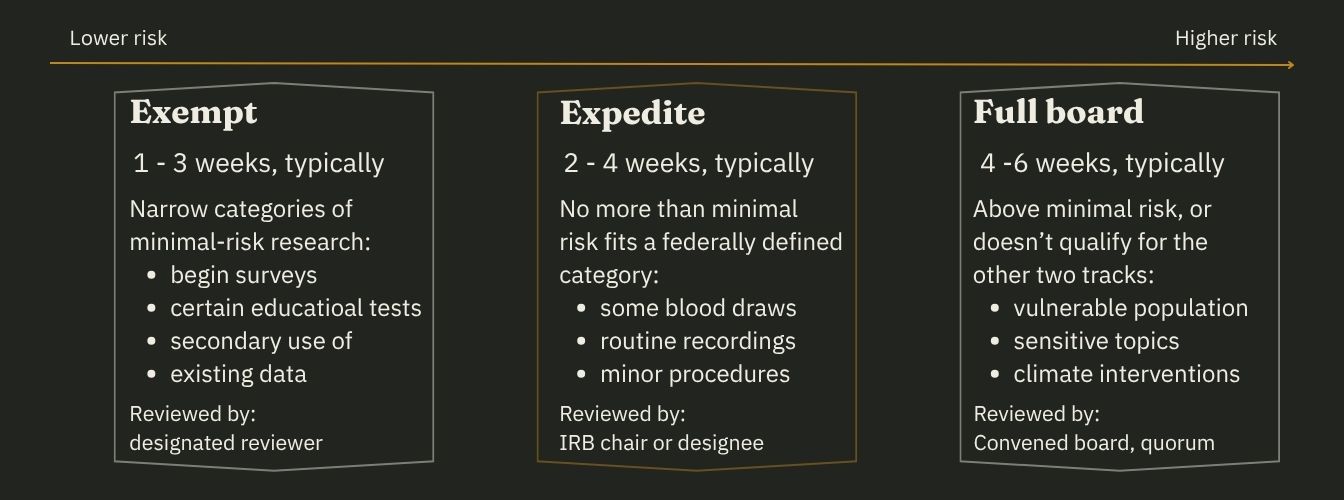
A low-risk, survey-based dissertation on a sensitive topic might be exempt. A modest clinical or intervention study might go full board. Neither review level says "this research matters more" in academic terms — it only signals different oversight needs. Read more on how review levels are determined.
Why does IRB commonly ask for revisions?
Most revision requests are about mechanics and compliance, not your topic. Here's what you're actually being asked to fix:
| Revision issue | Fix |
|---|---|
| Consent form missing required elements | Check 45 CFR 46.116 and add what's missing — purpose, procedures, risks, benefits, confidentiality, voluntary participation. |
| Consent written at too high a reading level | Rewrite at an 8th-grade level and define every term. |
| Protocol and consent don't match | Cross-check every document line for line — procedures, risks, compensation. |
| Recruitment materials overpromise or downplay risk | Reframe as neutral; describe compensation factually. |
| Missing protections for vulnerable populations | Add required safeguards — assent plus parental permission, a prisoner representative, and so on. |
| Incomplete training or documentation | Renew certificates; detail data storage, access, and retention. |
Notice what's not on this list: "Your question isn't important," "Your topic is boring," or "Your design is theoretically weak." Those are committee concerns, not IRB criteria.
Every fix in that table costs time, though — which is the part most people don't plan for.
How long does IRB review actually take?
Revisions add another round on top of whichever timeline your track already gives you. A minor revision — fixing a consent readability issue, say — might only need the chair's sign-off and add a week. A substantive revision that changes your risk profile or procedures may need to go back through the same review level it started at, adding the full cycle again.
Build IRB review into your proposal timeline the way you'd build in any other dependency, not as an afterthought after your proposal defense. If your study is likely to need full board review, that alone is a reason to submit early.
What that risk-versus-merit distinction actually looks like varies by case — these two show the range.
Two real examples
The distinction between risk and merit is easy to state in the abstract but harder to see in practice, so here are two actual cases. One is a fairly ordinary study; the other involves a vulnerable population and heavier review. Both got flagged for reasons that had nothing to do with whether the topic was worth studying.
A graduate student studying burnout among hospital nurses got three requests back: simpler consent language, a clearer explanation of how email and IP addresses would be stored, and a tweak to recruitment emails so they didn't imply participating would help the nurses' employment prospects. Each request addressed exposure or coercion — not the value of studying burnout. The board was narrowing risk, not weighing in on the topic.
A candidate studying disclosure patterns among survivors of intimate partner violence went to full board instead of expedited review, because the population was vulnerable and the topic sensitive — more scrutiny on consent language, debrief procedure, and what happens if a participant becomes distressed. Every added layer matched the study's risk profile, not the board's opinion of the topic. If anything, the extra procedural care reflected how seriously the study was being taken.
In both cases, the requests scaled with risk, not with how much the topic mattered — a low-stakes survey and a study on a vulnerable population each drew exactly the scrutiny their design called for, no more and no less. Whatever list of comments comes back on your own application, that's the pattern worth checking for first.
Can I start data collection before IRB approval?
Short answer: no. Beginning data collection without approval — even if you expect exemption — violates federal regulations and could invalidate your entire study.
Starting before approval breaches 45 CFR 46, regardless of risk level — a regulatory violation, not a technicality. It also invalidates your data: months of otherwise excellent work can become unusable without prior approval. And it can follow you afterward, since graduate schools and employers verify IRB compliance.
Wait for written approval before any participant contact, consent administration, or data collection. Use the waiting period to pilot your instruments or refine your analysis plan instead. The wait is real, and so is the frustration of a rejected first attempt — which is usually where the "just paperwork" comment comes from.
Why do advisors say "IRB is just paperwork"?
"Paperwork" isn't dismissive — it's actually good news. It means the issue is solvable and procedural, not a referendum on your research merit. Your job right now is compliance and clarity, not brilliance, and paperwork can be edited, resubmitted, and approved. Your research idea stays intact the entire time.
"IRB feedback is about how I'm doing the study, not whether the study deserves to exist." The board is required to disapprove studies that don't meet risk, consent, or privacy standards, regardless of how strong the underlying question is.
Does this mean my topic is bad?
No. A revision request is IRB responding to risk, consent, or paperwork, not to the merit of your idea — and even an outright disapproval usually comes down to the same thing: an unresolved risk or consent issue, not a rejected topic. Go back to the two examples above: the nurse-burnout study came back with consent-language and data-storage fixes, not a note questioning whether burnout was worth studying. The IPV disclosure study went to full board because the topic was sensitive and the population vulnerable — that's the system taking the topic more seriously, not less.
There's one case where a revision does say something about your idea: when a reviewer's comment is really a committee concern surfacing through the IRB process — for example, being asked to narrow your scope in a way that also happens to strengthen your design. That's uncommon, and worth raising with your advisor if it happens, but it's the exception, not what most revision letters are doing.
Knowing it's not about your topic is only half of this. The other half is working through what the letter is actually asking for — the checklist below walks through exactly that.
What should you do next?
If your IRB application was rejected or sent back for revisions, treat it like a technical revision, not a verdict on your topic — the IRB Revision Checklist below walks through each category.
- Map each comment to a specific requirement — consent, reading level, recruitment language, data security, or vulnerable populations.
- Fix inconsistencies between your protocol narrative, consent form, and recruitment materials — procedures, risks, and compensation need to match exactly, line for line.
- Simplify consent to an 8th-grade reading level, and define any term you can't cut.
- Detail your data-security plan — storage location, who has access, identifier separation, retention period.
- Add safeguards for vulnerable groups — assent plus parental permission for minors, a prisoner representative, and so on.
- Confirm training and sign-offs for every study team member.
- Recheck your review-level expectations against your actual design.
FAQ
Does IRB approval mean my research question is good?
No. That's what your committee is for — they judge whether the question is original or important. IRB only confirms the study is safe to run.
What is the difference between IRB and a dissertation committee?
IRB evaluates risk, consent, and regulatory compliance. Your committee evaluates theoretical grounding, methodology, and contribution to the literature.
What is the difference between exempt, expedited, and full board IRB review?
All three reflect risk level, not importance — exempt for narrow low-risk categories, expedited for no-more-than-minimal-risk studies reviewed by the chair, full board for anything above that.
Why did my IRB application get sent back for revisions?
Almost always mechanics, not your topic — missing consent elements, too high a reading level, a protocol-consent mismatch, or missing protections for a vulnerable population.
What if my study was disapproved outright, not just sent back for revisions?
Outright disapproval is rare and rarely means your topic was rejected — usually it's a risk or consent issue the board couldn't resolve. Ask your IRB office for the basis in writing and revise with your advisor.
Final thoughts
This list turns IRB feedback into a structured, solvable problem, not a verdict on your idea. Approval only clears you to proceed safely — it doesn't prove the dissertation matters, and that judgment was never the ethics office's to make. It belongs to your committee, your field, and your readers. Committee pushback gets misread the same way, for the same reason: not because the idea is weak, but because nobody specified who owns the fix. If a committee note is just as hard to parse as a revision request, reading unclear advisor feedback uses this same method. And if the real gap is the topic itself, narrowing the topic is the next move.
Working through revisions right now? The checklist below turns each comment into a solvable step.
Get the IRB Revision Checklist
Mapped to the same categories in this post — consent language, data security, vulnerable populations, and review-level expectations.
Get the checklist →
Rizwan Alam · Founder

Sehal Shakeel · Editor