


TL;DR
- A topic feels stuck when it's really two or three topics merged into one interest.
- Narrow it in three drafts: state the interest, add a population or context, then add a claim that makes it answerable.
- Run your draft-two topic through a search — too many close matches means it's already answered, almost none means it's narrowed too far.
- Stuck at draft three? Go back and narrow draft two further — that's normal, not a sign to start over.
Say your topic out loud, in one sentence. If you need a second "and" to finish it, that's the tell — not that the topic's wrong, but that it's still three topics standing in a trench coat. That's usually where it started — an interest wide enough to hold three or four topics at once, which is supposed to narrow twice: once into a topic, and again into a question. Most "topic trouble" is really a stall at the first narrowing, mistaken for the finish line.
How do you narrow down a dissertation topic in two steps?
Each draft adds exactly one thing.
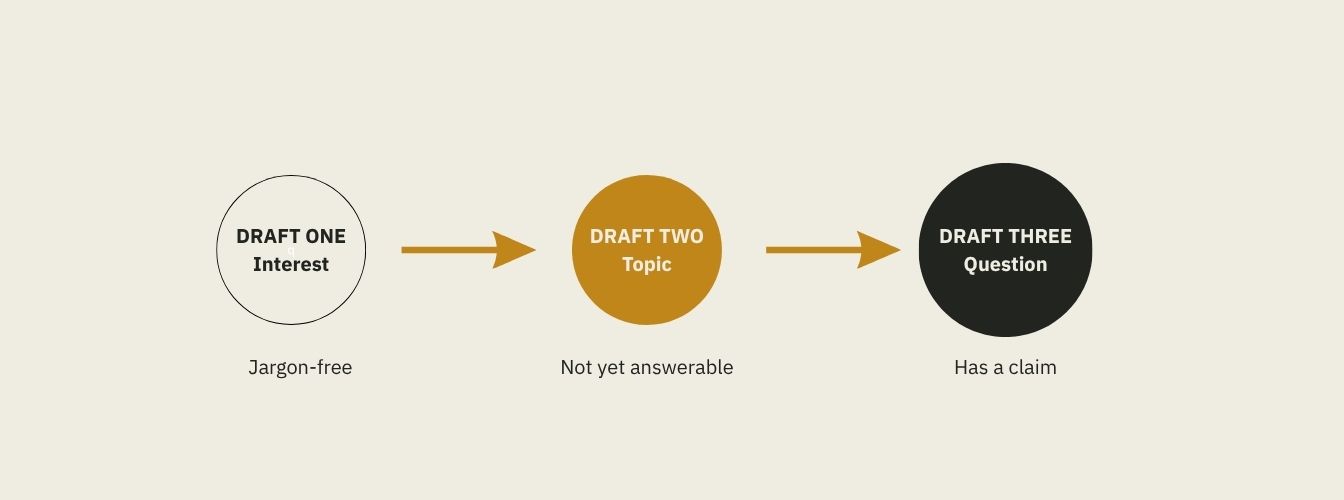
| Draft | What you add | Example |
|---|---|---|
| One — Interest | Nothing yet — just state it plainly, no jargon | "I'm interested in how small nonprofits handle a founder leaving." |
| Two — Topic | A population or context | "Leadership transitions in small nonprofits after a founding executive director departs." |
| Three — Question | A relationship, comparison, or gap | "Does a documented succession plan predict stability in the two years after a founder's departure?" |
Most candidates stop at draft two. They hand it to their advisor and treat it as finished. It isn't. A topic is a label for a corner of the literature — accurate, but not yet answerable. The second narrowing, into a real question, is the one that gets skipped. It can sit unfinished for months before anyone notices.
If you get stuck writing draft three, that's not failure — it's information. It usually means draft two is still doing an interest's job. Go back one step, narrow again, and try the jump a second time.
Why do two different topic problems feel identical?
Both too broad and too narrow produce the same sensation: you can't explain your topic in under thirty seconds without losing the thread. From the inside, that stuck feeling doesn't tell you which one you have — it just tells you something's wrong. Diagnosing which requires a test outside your own head, not a better attempt at explaining it out loud again.
Broad is the version most people show up with, and the tell is the same one from the last section — a second "and" needed to hold the sentence together. But narrow hides behind the same stuck feeling, dressed as boldness instead of confusion: a search on your closest sources turns up almost nothing nearby, and it's tempting to read that silence as proof you've found untouched ground rather than proof you've cut past what the field can recognize. (Purdue OWL's guide to literature reviews is a solid refresher if this step feels shaky.)
The stuck feeling is the same either way. The search results aren't.
That's the actual diagnostic: not how stuck you feel, but what comes back when you check. Most of the time it's neither extreme — it's a draft that stopped one narrowing too early, or went one narrowing too far.
What search actually tells you whether you're too broad or too narrow?
Take your draft-two topic — not draft three yet, the labeled version, before you've forced a claim — and run it through your database of choice using just the core terms, no added qualifiers. Pull the first twenty results that are actually relevant, not just returned. Google Scholar, JSTOR, ProQuest Dissertations & Theses, or your university library's database all work.
What you find sorts into three piles.
| Pile | What it means | What to do |
|---|---|---|
| Studies asking your question already | It's likely been asked | Say specifically what you're doing differently — population, method, or gap |
| Studies one step away (same population or variable, different angle) | Healthy result — a real conversation exists nearby | Proceed. This is "under-covered," not "uncovered" |
| Studies sharing only a keyword | Narrowed too far, not untouched ground | Widen back toward a conversation that already exists |
A gap in the literature and a gap in your search terms look identical from where you're sitting — the three-pile sort is what actually tells them apart.
Landing mostly in the third pile can feel like discovery, like you've found genuinely untouched ground. Usually it isn't. It just means the question needs to widen back toward a conversation that already exists, not that you're the first person clever enough to ask it. If the search itself feels shaky rather than just the topic, building a lit review with its own thesis makes this whole process easier.
What does this look like with a real pile of ideas?
One candidate had been talking his topic through with ChatGPT since the start of his degree — not to write anything, just to think out loud with, on and off, for months. By the time he sat down with me, he had somewhere north of a dozen "directions," and he couldn't tell me which one was actually his topic, because none of them had ever really stopped being an interest.
I didn't pick a favorite out of the dozen. I took the one he kept returning to and ran it through the three drafts. As an interest, it was broad enough to fit half the pile inside it. As a topic, it narrowed to something nameable — but he still couldn't say it in one sentence without an "and" pulling in a second variable that belonged to a different one of his twelve ideas.
"Two of his twelve ideas had never actually been separate — they were one topic that hadn't finished narrowing."
Splitting them, then running the smaller one through the search check, took about forty minutes. Draft three came out of that same session. The other eleven ideas didn't get discarded so much as quietly absorbed — most of them turned out to be the same handful of variables, recombined.
What do you do when your committee disagrees with your scope?
One reader tells you to narrow further. Another says it's fine as-is. Your own instinct is doing a third, different thing entirely. It's tempting to conclude the topic itself is doomed. It usually isn't.
What you're looking at is a scope disagreement, not a verdict on your judgment — and scope disagreements get resolved by asking a specific question, not by quietly picking a side and hoping nobody notices. (Same skill as reading vague advisor feedback: turning an ambiguous note into a specific, answerable question. The Council of Graduate Schools has broader guidance on managing committee relationships if this comes up often.)
"I've gotten different reads on scope from [Reader A] and [Reader B] — could we settle on one direction? Happy to draft both and compare if that's useful."
There's a quieter version of the same problem, and it might be more common than open disagreement: nobody says anything at all. No conflicting notes, no pushback — just silence, while your own uncertainty about scope sits there unresolved. It's tempting to read that silence as approval. Sometimes it is. Just as often, it means scope hasn't actually been reviewed yet, and the fix is the same either way — ask directly instead of waiting for it to resolve on its own.
"Before I go further, I want to check scope specifically — does [topic] feel like the right size, or should I narrow further first?"
What's a five-minute check before you touch the topic again?
Run these three before you conclude anything else about the topic:
- Say it in one sentence and count the "and"s — two or more is still a trench coat.
- Spend fifteen minutes searching your closest sources — some hits but not your exact angle is healthy; almost nothing means narrowed too far.
- Try writing draft three. Stuck there, not at draft two? That's not the topic failing — that's exactly where the work is.
FAQ
How do I know if my dissertation topic is too broad?
If you need a second "and" to say it in one sentence, it's still doing the job of an interest, not a topic. A search will also turn up too much undifferentiated ground instead of a specific gap.
How do I know if my topic is too narrow?
If a search on your closest sources turns up almost no surrounding conversation — not just an under-covered angle, but nothing to join at all — it's likely been narrowed past what the field can recognize.
What's the difference between a research interest and a research topic?
An interest is the one-sentence, jargon-free version of what draws you to the subject. A topic adds a population or context, narrowing it into a label for a corner of the literature — accurate, but not yet answerable.
Do I need to start over if I still can't state my topic in one sentence?
No. Most of the time the underlying interest is fine — it just hasn't been through the second narrowing yet, from topic into an actual question with a claim in it.
Final thoughts
None of this requires a new topic. Learning how to narrow down a dissertation topic isn't about finding a better idea somewhere out there — it's about finishing the draft you're already standing in the middle of. Say it out loud, count the "and"s, run the search, and see which of the two narrowings you actually stalled on. Most of the time, the topic was never the problem. It just hadn't been asked yet.