


TL;DR
- A literature review needs a claim, not just a summary of sources.
- Organize by theme or tension, not source-by-source — pick the method that fits your field.
- Synthesize sources against each other; don't just describe them one at a time.
- If a reader can't state your field's gap in one sentence after reading it, it's not done yet.
"Why do you need this objective? Highlight the value — is there a benefit going underutilized, or one that opens up a new opportunity?" That's the actual feedback a client got on their literature review's objectives. A second note asked the same thing about a different objective: "What's the purpose of determining these challenges? Can you solve them?"
Twenty-plus sources, careful reading — and the reviewer still had to ask why any of it mattered. That's the gap how to write a literature review actually closes: not more sources, but a reason for them.
Why does my literature review read like a bibliography?
The client's draft above followed the same shape for every paragraph: one researcher's finding, then another's, then a third's — each sentence citing a different name, each one true, none of them building toward anything. Twenty-plus sources, and by the end, no sentence in the entire review stated what the writer actually thought about the field.
That's the trap. Organizing by source feels thorough — it looks like you've read everything. But one citation per paragraph is usually a sign you're summarizing, not synthesizing — and a reader finishing a review built that way can't tell you, in one sentence, what you think about the field.
A literature review without a claim is a bibliography with better formatting.
That's not a matter of style. A committee reading a source-by-source review has to do the work of finding the pattern themselves — and if they have to do that work, they'll assume you never found it either.
What makes a literature review different from a summary?
The two are easy to confuse because a literature review contains summaries — but summarizing isn't the whole job. Here's what separates the two:
| Summary | Literature review |
|---|---|
| Reports what one source found | Argues what multiple sources mean together |
| Organized study by study | Organized by theme, tension, or gap |
| Any paragraph can be reordered without changing its meaning | Paragraphs depend on being read in sequence — remove one, the argument breaks |
| Ends when the last source is described | Ends with a stated gap or claim about the field |
| Reader learns what happened in each study | Reader learns what you think about the field |
Every one of these comes down to the same thing: you can shuffle a summary; you can't shuffle a literature review. If you can swap two paragraphs in your draft and nothing changes, you're still summarizing.
Want to check your own draft against this before moving on? The chapter outline guide breaks down how the literature review chapter connects to the rest of your thesis — worth a look if you're not sure your chapter is doing its actual job yet.
What are the different ways to organize a literature review?
A disorganized literature review usually isn't badly written. It just never picked one of four ways to organize it. Which one you pick depends on what your sources actually do — agree, disagree, build on each other over time, or use different methods.
A deliberate choice looks like this in practice — a real table of contents from a literature review on sustainable real estate in the UAE:
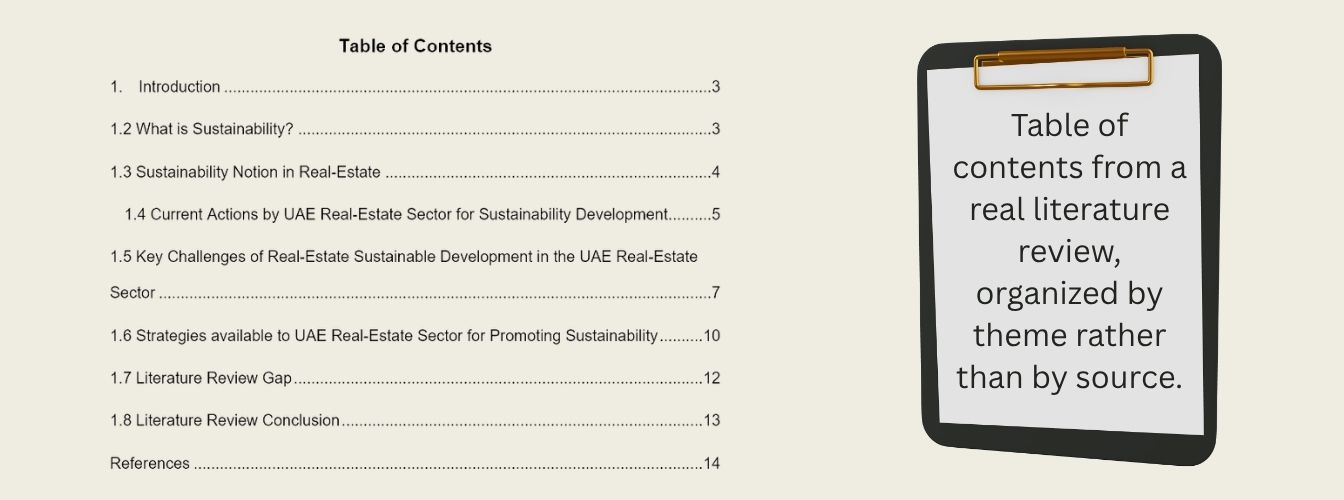
Look at the headers: "What is Sustainability?", "Sustainability Notion in Real-Estate," "Current Actions," "Key Challenges," "Strategies," then a "Literature Review Gap" section before the conclusion. Not one author name in that list. Each heading is a theme — and the sources get folded into whichever theme they support.
USC's research guide breaks literature review structure into four approaches:
| Structure | How it's organized | Best for |
|---|---|---|
| Thematic | By topic or theme (like the example above) | Most social science and business topics |
| Chronological | By how the field's thinking changed over time | Fields where the argument is historical development |
| Methodological | By research method used (qualitative vs. quantitative, case study vs. survey) | Reviews comparing how different methods reached different conclusions |
| Dialectical | By where sources agree vs. disagree | Reviews built around a specific debate or tension |
Thematic is the most common default, and it's what the UAE example uses — but the right choice depends on what your field's actual disagreement looks like. If sources mostly clash over method, organize by method. If they clash over findings, organize by theme or dialectically.
How do you find your literature review's organizing claim?
A real gap statement names what's missing, specifically. One example, from the UAE real estate review: the analysis, it admits, "is somewhat generic" and never actually connects the general sustainability literature to the UAE market. That sentence is the whole chapter's argument — except it shows up in the last section, as an afterthought, instead of setting up everything before it.
Most students write their gap statement last, the way this one did, because they only figure out what's missing after they've already written the summary. That's backward. Work out the gap first, even roughly, and every section you write afterward has a job: support it, complicate it, or narrow it down.
You have one concrete way to find it. Go through your sources and sort them into three piles: what most of them agree on, what a few of them argue against each other about, and what none of them actually cover. The third pile is usually where your claim lives — not because it's the most interesting, but because it's the one thing your study can actually add.
Once you have a rough claim, test it the same way you'd test a thesis statement: could someone reasonably argue the opposite? If yes, it's a real claim. If everyone would agree with it immediately, it's too vague to organize a chapter around — go back and narrow it further.
Write the finished version as one sentence, and put it near the start of the chapter, not the end.
What does a strong literature review example look like?
Everyone wants a quick fix — a checklist, a formula, a shortcut. But if you're looking for good examples of literature review writing, the fastest way to learn is contrast: one paragraph that does the work, one that doesn't.
A weak paragraph stops after reporting what a source said. A strong one keeps going — it makes a claim, lets something push back against it, then resolves that tension. Three moves, not one.
The UAE sustainability review does this well.
It states the theory. Then it raises an objection — the profit focus undermines the "people and planet" framing. Then it answers that objection: profit also funds tax revenue and social benefit.
That third move is what makes it a real paragraph instead of a summary. The writer took a position instead of leaving the objection hanging.
This is what's missing when that third move doesn't happen.
In a different client's literature review, one source argued that big data is hard to manage at the scale eCommerce produces it. The very next sentence cited another source showing that big data breaks down into distinct, manageable types — a direct counter to the first claim.
Both sentences made it into the paragraph, back to back. Neither one said which side actually holds up, or what the disagreement meant for the study.
If your own paragraph stops right after a disagreement shows up, that's the fix: add one more sentence saying which side holds up, and why.
How do you restructure a literature review that's already written?
A finished draft that's organized wrong doesn't need to be rewritten — it needs to be reorganized. Most people assume the opposite, and end up rewriting sentences that were already fine, just sitting in the wrong place.
Use a reverse outline instead — a technique Wisconsin's writing center recommends for exactly this problem: read your draft and write one sentence next to each paragraph stating its main point, nothing else.
Once you've done that for the whole chapter, read just the sentences, in order, ignoring the paragraphs underneath them. If they read like a list of unconnected facts, your draft is still organized by source. If they read like an argument building toward something, the structure is already there — the paragraphs just need reordering to match.
Group the one-sentence summaries by theme or tension instead of by the order you wrote them in. Studies that agree go together. Studies that conflict go together. Anything left over that doesn't fit either group is often where your gap statement is hiding.
This is usually a reorganization, not a rewrite — which is exactly how to write a literature review revision that doesn't cost you another two weeks. You're moving blocks of text you've already written, not producing new ones.
If restructuring keeps eating into time you'd budgeted elsewhere, it's worth checking how long writing a dissertation actually takes so you can plan around it instead of losing a week you didn't have.
What are the most common literature review mistakes?
Both client examples used throughout this post point to the same handful of failures — not typos or grammar, but structural choices that undercut the whole chapter.
| Mistake | Why it fails |
|---|---|
| One source per paragraph | Reads as summary, not synthesis — exactly the eCommerce review's pattern |
| Unjustified objectives | A reviewer has to ask why the objective matters, the way the eCommerce feedback did |
| Gap statement buried at the end | The UAE review's actual argument only shows up in the second-to-last section |
| Disagreement reported, never resolved | Two sources contradict each other, and neither writer says which one holds up |
| No stated organizing method | Structure happens by accident, not by a deliberate choice between thematic, chronological, methodological, or dialectical |
The pattern across all five: something the writer noticed — a contradiction, a weak justification, a real gap — never made it onto the page as a stated claim. The reader is left to find it themselves, and most won't bother.
What should you check before you finalize it?
- Can you state your literature review's argument in one sentence?
- Does each paragraph have more than one source in conversation, not just one?
- Does every disagreement between sources get resolved, not just reported?
- Is your gap statement near the start of the chapter, not buried at the end?
- Did you pick one organizing method — thematic, chronological, methodological, or dialectical — on purpose?
- Would a reverse outline of your draft read like an argument, or like a list?
FAQ
How to start a literature review
Not by summarizing your first source. Group your reading notes by theme or disagreement first — know your claim before you write a word.
How long should a literature review be?
It varies by program and field. Check your department's word count guidance instead of assuming a standard length.
What's the difference between a summary and a synthesis?
A summary reports what one source found. A synthesis says what sources mean once compared — where they agree, where they clash.
Can I organize my literature review by author instead of by theme?
You can, but it usually produces a list, not an argument. Save it for cases where tracing one researcher's work over time is the actual point.
Do I need to include every source I read?
No. Include what builds your argument. Anything else belongs in a further-reading list, not the chapter body.
Final thoughts
A literature review isn't judged on how many sources it cites — it's judged on whether it argues something. Every mistake in this post comes down to the same root cause: a writer who noticed something (a contradiction, a gap, a weak justification) and never said so on the page. Pick an organizing method, state your claim early, and make every paragraph do more than report what a source said. That's how to write a literature review that a committee actually wants to read.