


TL;DR
- Most dissertations use five chapters — intro, lit review, methodology, results, discussion — confirm your program's exact rubric.
- Required sections rarely cause problems; institutions specify those already.
- An outline's job is showing what each chapter owes the next, not just what goes inside it.
- Outlining chapters in isolation is the top cause of a disconnected dissertation.
- The transition-sentence test catches this before you draft, not after.
A dissertation chapter outline template maps what belongs in each of the five core chapters — introduction, literature review, methodology, results, and discussion — and what each chapter needs to establish for the one that follows. Use it before you start drafting, so every chapter has a clear job, not just a list of required sections.
Here's a version of this that happens constantly: every chapter hits its required sections. The introduction has a clear problem statement. The literature review is thorough. The methodology is sound, the results are reported cleanly, the discussion draws reasonable conclusions.
On paper, using any standard dissertation chapter outline template, nothing is missing. And still, reading it start to finish, something doesn't sit right. It reads like five separate, competent reports rather than one sustained piece of work. Nobody can quite say why — including, often, the person who wrote it. The reason is almost never a missing section. It's a missing connection.
A chapter outline template tells you what belongs in each chapter.
A strong dissertation chapter outline also tells you what each chapter needs to establish for the one that comes next — and that's usually where a dissertation either holds together or falls apart.
What actually goes in a dissertation chapter outline template
The section list itself isn't usually where things go wrong. Most universities hand you a rubric or required structure, and it looks close to this regardless of discipline. So what is a dissertation chapter outline, in practical terms? It is a working map of the chapters, their major sections, the evidence or claims each section will carry, and the reason the next chapter needs what comes before it.
| Chapter | What it covers | What it owes the next chapter |
|---|---|---|
| Introduction | Background, problem, purpose, research questions | A question the reader wants answered |
| Literature review | Theory and prior research, organized by theme | A named, specific gap |
| Methodology | Design, sample, data collection, justification | What a reader should look for once results arrive |
| Results | Findings, reported with restraint | Everything the discussion will need to interpret |
| Discussion | Meaning, limitations, contribution | — |
Think of the chapter list as the skeleton of your dissertation chapter structure. The outline becomes useful when each heading has a job: it should tell you what you will establish, what evidence you will use, and how that work prepares the reader for the next section.
If you have your committee's specific rubric, use it over any generic template — institutional requirements vary in small but real ways. But the section list, on its own, is the easy part. Knowing what goes in a chapter and knowing what that chapter needs to accomplish for the next one are two different skills. Only the second is hard to find good guidance on.
That distinction matters when you adapt a dissertation structure template: keep the required headings, but make the logic underneath them yours.
How do dissertation chapters connect?
A dissertation is one long argument made across five installments. Each chapter's job isn't just to cover its topic — it's to leave the reader in the right place to understand the next one.
Take the literature review. Filled in as a checklist, it becomes a summary of what other people found, organized by theme, thorough, and ultimately inert. Outlined with the next chapter in mind, the same material does something more specific: it builds toward a gap, precisely enough that your methodology chapter reads as the obvious next move rather than an arbitrary choice.
The same logic applies moving into results. A methodology chapter outlined in isolation describes your design. Outlined with the next chapter in mind, it sets up specific expectations — what a reader should look for once they reach your findings.
And it applies again from results into discussion. A results chapter outlined as a checklist just reports what happened. Outlined with the throughline in mind, it's written knowing exactly which findings the discussion chapter will need to lean on. This is the difference between chapters that merely follow one another and chapters that depend on one another.
Every chapter should leave a debt the next one has to pay. If you can't say what a chapter owes the one after it, that's not a minor gap — it's the reason the whole thing can read as five reports instead of one argument.
A dissertation isn't five correct chapters. It's one argument that happens to be organized into five parts. If you can remove a chapter and the others don't visibly need it, that's the tell.
Why can a dissertation outline feel complete but still disconnected?
Nothing about outlining chapter-by-chapter feels wrong while you're doing it. Each individual outline can look complete — every section present, reasonably detailed. The problem only becomes visible reading the chapters in sequence, and by then three of them are often already drafted.
Most students understand, at some level, how their chapters connect — they can usually explain it out loud if asked directly. The connection just never got written down. It lived in their head while planning, and by the time they were drafting Chapter 4, that plan was three weeks old and slightly different from the one in their head when they wrote Chapter 2.
This is also exactly the kind of gap that tends to surface in a defense — a committee member asks how the methodology connects to a theme from the literature review, and the honest answer requires reconstructing a connection that was never written down, live, under mild pressure.
Better to find it now, on a page, than there. The fix is simple enough to test before drafting: read the outline horizontally, not only chapter by chapter — ask what each chapter is supposed to hand off to the one after it.
| Transition | Ask this | If the answer is vague |
|---|---|---|
| Introduction → Literature review | What question does the introduction leave the reader wanting answered? | The literature review has no organizing focus |
| Literature review → Methodology | What specific, named gap does the literature review point to? | The methodology reads as an arbitrary choice |
| Methodology → Results | What should a reader be watching for once results arrive? | Findings will read as a data dump |
| Results → Discussion | What will the discussion need results to have already shown? | Discussion's claims won't be supported |
If your answer to any of these lands somewhere close to the "vague" column instead of a specific one, you have found the weak link — and it is far cheaper to fix on the page now than to reconstruct it live in front of a committee.
Where the outline test catches problems
The most common failure looks like this: a literature review that's genuinely well-organized on its own terms, paired with a methodology chapter that's equally solid on its own terms — but nothing in either one states the connection between them.
The transition-sentence test catches this specifically, because "the literature review needs to have established ___ for the methodology to make sense" is hard to fill in vaguely when there's nothing there to point to.
The same test works in the other direction too: if a discussion outline makes a claim the results outline never planned to support, that mismatch shows up as soon as you try to write the transition sentence. While it's still a one-line fix, not a rewrite three chapters deep. That is exactly when an outline earns its keep: it exposes an argument problem while the cost of changing it is measured in bullets, not pages.
How detailed should a dissertation chapter outline be?
A related problem shows up even when the throughline is genuinely there. Some chapters get outlined in real detail. Others get a few bullet points and a note to "fill in later."
Usually the introduction and literature review get the careful treatment — written earliest, when energy is highest — while methodology, results, and discussion get outlined thinly, on the assumption they'll get worked out once there's real data to react to.
The trouble is a thin outline for a later chapter often means the throughline check never really happens for it either. It's hard to write an honest "for this chapter to make sense, the previous one needs to have established ___" sentence when the chapter itself is still just a placeholder.
Your outline does not need every paragraph or citation. It should be detailed enough to show the chapter's purpose, its major sections, the evidence or claims you expect to use, and the transition into the next chapter. For a sense of how long each chapter usually runs, see dissertation length by chapter.
How to outline a dissertation in two passes
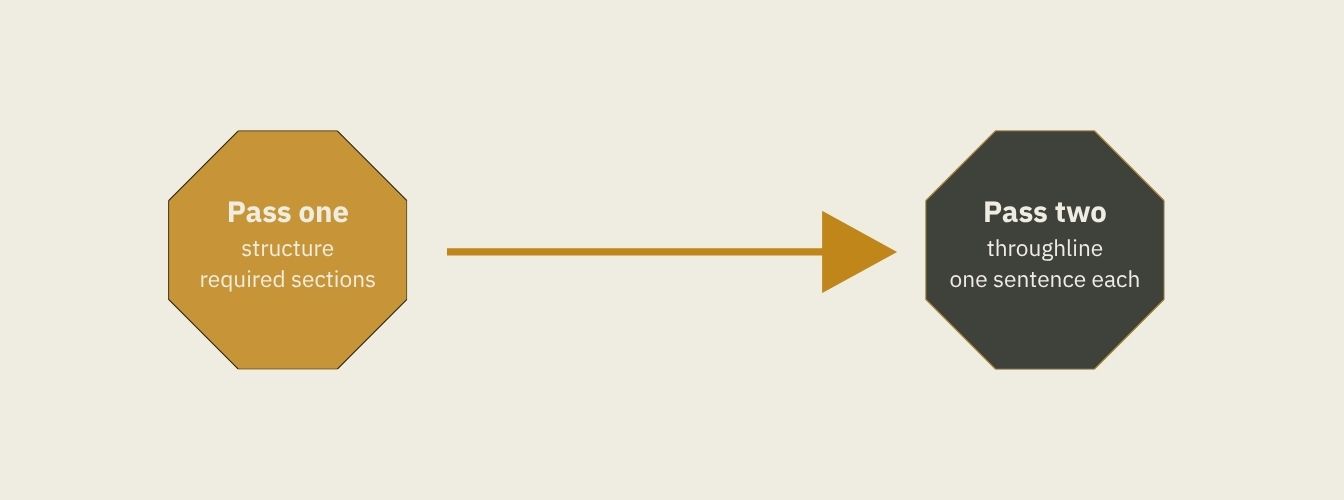
Work through this in two passes, not one. Pass one — the standard structure. Outline each chapter against your institution's required sections. This is the easier half — mostly making sure nothing required is missing. Pass two — the throughline. Go chapter to chapter and write one sentence for each transition: "for [next chapter] to make sense, this chapter needs to have established ___."
For example: "for the methodology chapter to make sense, the literature review needs to have established that no existing study has looked at this population using this method."
If you can write that sentence cleanly for every transition, your chapters are connected. If you get stuck, that's the real gap in your outline. Not a missing section. A missing connection. George Mason University's Writing Center frames this same principle at the paragraph level: coherence comes from deliberately connecting ideas, not from covering the required content in order.
If you are using a dissertation outline template example, compare its structure with your own research question before adopting it. A template can show you the shape of a chapter; it cannot decide which claims, evidence, or transitions your study actually needs.
This second pass takes far less time than it sounds. Usually under an hour once pass one is done. The University of Bath's academic skills guidance makes the same point about dissertations specifically: every chapter and heading should link directly back to the research question, not just fill the section it was assigned.
A five-minute checklist before you start drafting
Run through this against your current outline before you write a single full chapter:
- Trace intro → lit review → methodology → results → discussion — if any one transition won't come, that's your gap.
- Check whether any chapter is noticeably thinner than the others, beyond what its section calls for.
- Confirm that every claim discussion plans to make is one results has already planned to support.
- Write one sentence per chapter explaining how it advances the question — vague language means revisit before drafting.
- Work backward from your intended discussion or conclusion to catch missing evidence before it becomes a drafting problem.
Once your outline passes both checks, the work that follows is just following through on the plan you've already made.
One chapter at a time, each one already knowing what it owes the next. The goal is not the longest possible outline. It is an outline that makes the dissertation's logic visible before you spend weeks turning that logic into prose.
FAQ
What is a dissertation chapter outline template?
A working map of your chapters — their major sections, the evidence or claims each section will carry, and what each chapter owes the one that comes after it. It is a planning document, not a miniature draft.
How many chapters does a dissertation usually have?
Most follow five core chapters — introduction, literature review, methodology, results or findings, and discussion — though the exact structure depends on your institution and discipline, so check your program's rubric before adopting any generic structure.
Why does a dissertation outline feel disconnected even when every section is present?
Because chapters were outlined in isolation rather than against each other. Every required section can be present and the whole thing can still read like five separate reports if no chapter states what it owes the next one.
How do I know my chapter outline is detailed enough?
Detailed enough to show each chapter's purpose, its major sections, the evidence or claims you expect to use, and the transition into the next chapter, but not every paragraph or citation.
What is the transition-sentence test?
For each chapter-to-chapter transition, write one sentence: "for [next chapter] to make sense, this chapter needs to have established ___." If you get stuck, that gap — not a missing section — is where the outline needs work.
Final Thoughts
A dissertation chapter outline template will always tell you what belongs in each chapter — that part is rarely where things go wrong. What decides whether the finished dissertation reads as one argument or five competent reports is whether each chapter's outline states what it owes the next. Run the transition-sentence test before you draft, not after, and the connective tissue gets fixed while it still costs a sentence instead of a rewrite.