


TL;DR
- Vague feedback isn't negligence — it's compressed, usually from being overworked or repeating a phrase out of habit.
- Run any vague note through one question: "What would this page need to contain for my advisor to stop writing that comment?"
- Write the answer as a to-do, not a feeling.
- If that fails, ask a specific, two-option follow-up question instead of guessing.
What if the problem isn't that your advisor's feedback is vague — it's that it was never meant to be read alone? A short comment in a margin was never going to carry a full explanation. It's a pointer, not a paragraph — and pointers only work once you know what they're pointing at.
Why does advisor feedback feel so vague?
Vague feedback isn't negligence. It's overwork wearing a polite mask. An advisor reading almost twenty drafts a week doesn't have the bandwidth to write "your third paragraph mixes correlation and relationship" — so it becomes "needs more depth," and you are left guessing. Other times it's the opposite problem: the advisor expects you to already know what "more rigor" means, because for them it's obvious.
And sometimes it's just fatigue — they've said the same three words to fifty students before you, and don't notice anymore that the phrase means something different every time. None of it is really about you. It's about what didn't get said.. The pattern I see most: advisors move the goalposts. A student fixes what round one asked for.
Then round two wants something new — not because the student got it wrong, but because the advisor's thinking changed. No one says this out loud. The student just feels like they failed, when really the ground just shifted.
What do common vague feedback phrases actually mean?
A handful of phrases come up constantly enough that they're worth translating in advance — here's what each one usually means:
| Phrase | What it usually means |
|---|---|
| "Needs more depth" | You described what happened but didn't explain why it matters |
| "Unclear contribution" | I can't tell what's new here versus what's already been said |
| "Tighten this section" | You're making one point three times |
| "Consider the literature more carefully" | You're missing a source your advisor expected to see |
| "Support this claim" | You wrote a sentence that sounds true but isn't backed by anything — no citation, no data, no example |
| "This needs more rigor" | There's a step in your reasoning your advisor can see the gap in, even if they can't point to exactly where |
| "Too descriptive" | You told the reader what happened, not what it means — the analysis is missing, not the narrative |
This isn't just a hunch about how advisors write comments. McGill University's graduate supervision guidance draws the same line: vague comments don't explain or address the actual problem, while specific, constructive comments speed up revision by cutting down guesswork.
Seven phrases, one pattern: every vague note is standing in for something specific your advisor didn't have time — or didn't think — to spell out. Vague feedback isn't useless. It's compressed. Your job is to decompress it.
What does this look like on a real page?
Take a comment like "Reword — this sounds confusing," attached to a sentence introducing a theoretical framework: "The study will be making use of various theories throughout the research study. Requirements Chain Management, it is related to the modification of the supply chain process of the organization to meet the expectations and requirements of the customers."
On its own, "confusing" doesn't say what to fix. Run it through the translation, and the actual problem surfaces: the sentence never states what Requirements Chain Management is before using it — "it" has no clear referent, and the theory's name is dropped in without being defined as a concept first. The fix isn't a vaguer version of the same sentence. It's a specific rewrite that names the theory, defines it, then states its relevance — in that order:
"This study draws on Requirements Chain Management, a framework concerned with modifying an organization's supply chain processes to align with customer expectations and requirements."
The same comment appeared again a few lines later, on: "It ensures to provide maximum operational efficiency to the jeans organizations for scoring desired profits or sales (Fernie and Sparks, 2018)."
Same diagnosis, same fix: "it" has no antecedent, and "scoring desired profits" reads as filler rather than a claim. Rewritten with the missing referent restored: "Requirements Chain Management ensures maximum operational efficiency for jeans manufacturers, supporting stronger profit and sales outcomes (Fernie and Sparks, 2018)."
Two identical comments, two identical causes: a pronoun standing in for a noun the reader never got. Once you can name that pattern, "reword — confusing" stops being a mystery and becomes a checklist: find the "it," find what it's supposed to mean, and put the real word back.
How do you turn a vague note into an actual task?
Take the vague note and ask one question: what would this page need to contain for my advisor to stop writing that comment?
Write the answer as a to-do, not a feeling. "Needs more depth" becomes "add two sentences explaining why this result matters for the argument in the next chapter" — not "make this deeper."
If you genuinely can't answer that question, that's useful information too. It usually means the note isn't really about the sentence it's attached to, but about a structural gap earlier in the chapter. A second technique: look at where the comments cluster.
If three separate pages get some version of "needs more depth," don't treat them as three separate edits — check whether they share a cause. Say a student gets that comment on page 6, page 11, and page 15 of a results chapter. Fixed individually, that's three patch jobs.
But trace them back, and often the real gap is one missing paragraph early in the chapter — a stated stake, a framing sentence — that would have prevented all three comments if it had been there from the start. Fix the shared cause once, and the individual comments resolve on their own.
Why do advisors give vague feedback in the first place?
Nobody trains advisors to give feedback. They're hired for research output, not pedagogy, and the skill of turning a diagnosis into an instruction is never formally taught — it's absorbed, if at all, from how their own advisor commented on their drafts twenty years ago.
This isn't unique to your advisor. A survey of faculty in one academic department found most had no formal mentor of their own, and most of those without one wanted it — the same absence of formal structure extends to how faculty are expected to give feedback to the students they supervise. So the vagueness doesn't start with you. It's inherited.
There's also a structural mismatch nobody names out loud: a department expects one advisor to give the same depth of attention to five, ten, sometimes twenty students at once, with no reduction in their own research or teaching load to make room for it. Careful, specific feedback takes real time per page.
When that time doesn't exist, the note gets shorter — not because the advisor cares less, but because the system never budgeted for longer. And there's no feedback loop on the feedback itself.
Nobody tells an advisor "that comment didn't help" and expects them to revise their approach. Students absorb the cost of vague notes silently, revise as best they can, and the pattern repeats with the next cohort.
None of this is a reason to accept a vague note as final — it's a reason to stop taking it personally. (The same advisor-driven shift shows up in dissertation timelines generally — scope changes that aren't your fault still cost real time.)
When should you just ask your advisor directly?
Translating feedback yourself is a skill worth building, but it isn't a substitute for asking. A single follow-up email — "When you say X, do you mean Y or Z?" — saves you from spending two weeks addressing the wrong problem.
The phrasing matters. A vague question gets a vague answer back, so the goal is to hand your advisor two concrete options instead of an open floor. Take a paragraph like this one, flagged "Need more depth. Explain it further.":
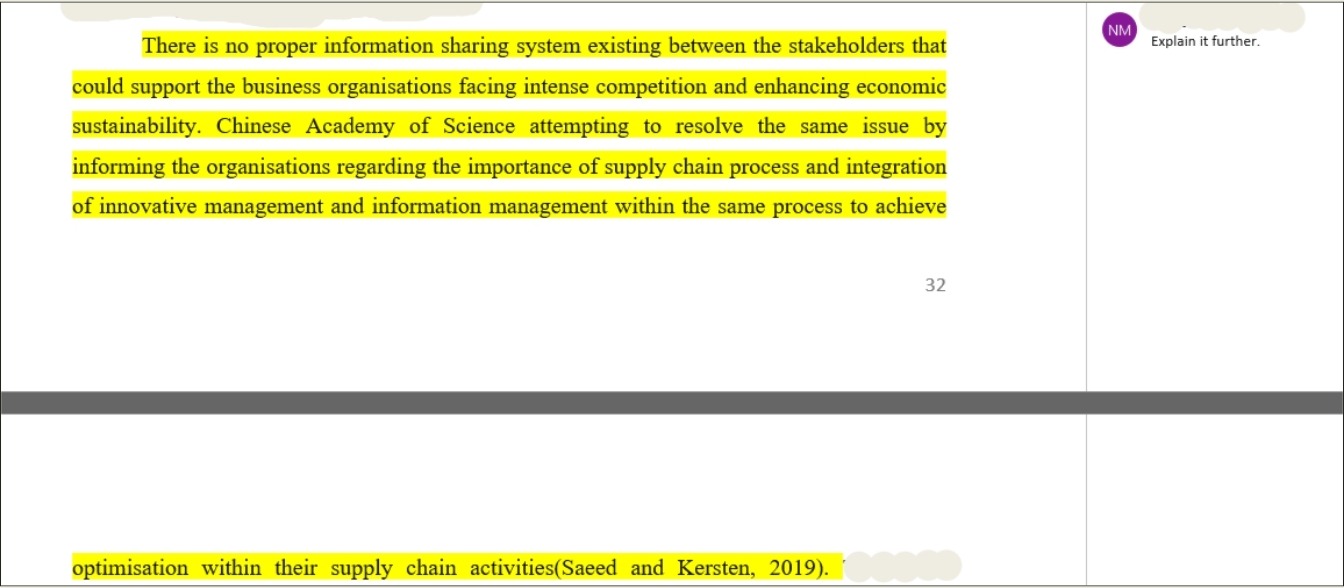
Not every follow-up question gets the same result. The difference comes down to whether you ask your advisor to explain again, or you give them something to simply confirm.
"Can you clarify what you meant by 'need more depth, explain it further' on this paragraph?"
The question above hands the work back to your advisor. They already formed the thought once. Now they have to reconstruct it from memory, in a reply email, with no paragraph in front of them. Most advisors don't have time for that. The question gets a one-line non-answer, or no answer at all.
"On this paragraph about the Chinese Academy of Science and supply chain integration — when you wrote 'need more depth, explain it further,' did you mean I should explain how they're addressing the information-sharing issue in more detail, or explain why this example is relevant to the argument I'm building? I want to fix the right thing before I revise."
The second version does the decompression work for the advisor instead of asking them to redo it from scratch. It's also easier to answer in thirty seconds between meetings, which makes a fast, useful reply more likely. Advisors respect a specific question far more than they respect silence followed by a guess.
FAQ
What if I ask my advisor to clarify and they give the same vague answer again?
Stop asking. Start proposing. Send your interpretation instead of another question. Example: "I read 'needs more depth' as explaining why this finding matters for Section 3. Is that right, or something else?"
Is it unprofessional to ask an advisor what they meant by a comment?
No. It shows you're getting it right. You're not guessing.
How do I know if feedback is about my writing or about my argument?
"Tighten this" or "unclear" points at the writing. "Needs more depth" or "more rigor" points at the argument. Still unsure? Ask if the fix belongs in a sentence or in new evidence.
What if different advisors on my committee give conflicting feedback?
Don't compromise-edit. Name the conflict. Say: "Advisor A suggested X, Advisor B suggested Y. How should I reconcile this?" Same move applies when your committee disagrees on scope — the fix is the same: surface it, don't guess.)
Final thoughts
Vague feedback feels like a wall. It arrives with no obvious next step. But it's rarely as final as it sounds. Behind almost every short note is a missing sentence, a missing source, or a missing piece of reasoning. Your advisor didn't have the time, or the words, to spell it out. The one-question test, tracing where comments cluster, or a precisely framed follow-up question will usually surface what that something is. None of this makes the feedback less real. It doesn't mean the note was thoughtless. It means the translation step is part of the revision process, not an obstacle in front of it. The candidates who move fastest through revisions aren't the ones who get the clearest notes. They're the ones who've gotten good at reading the unclear ones.