

TL;DR
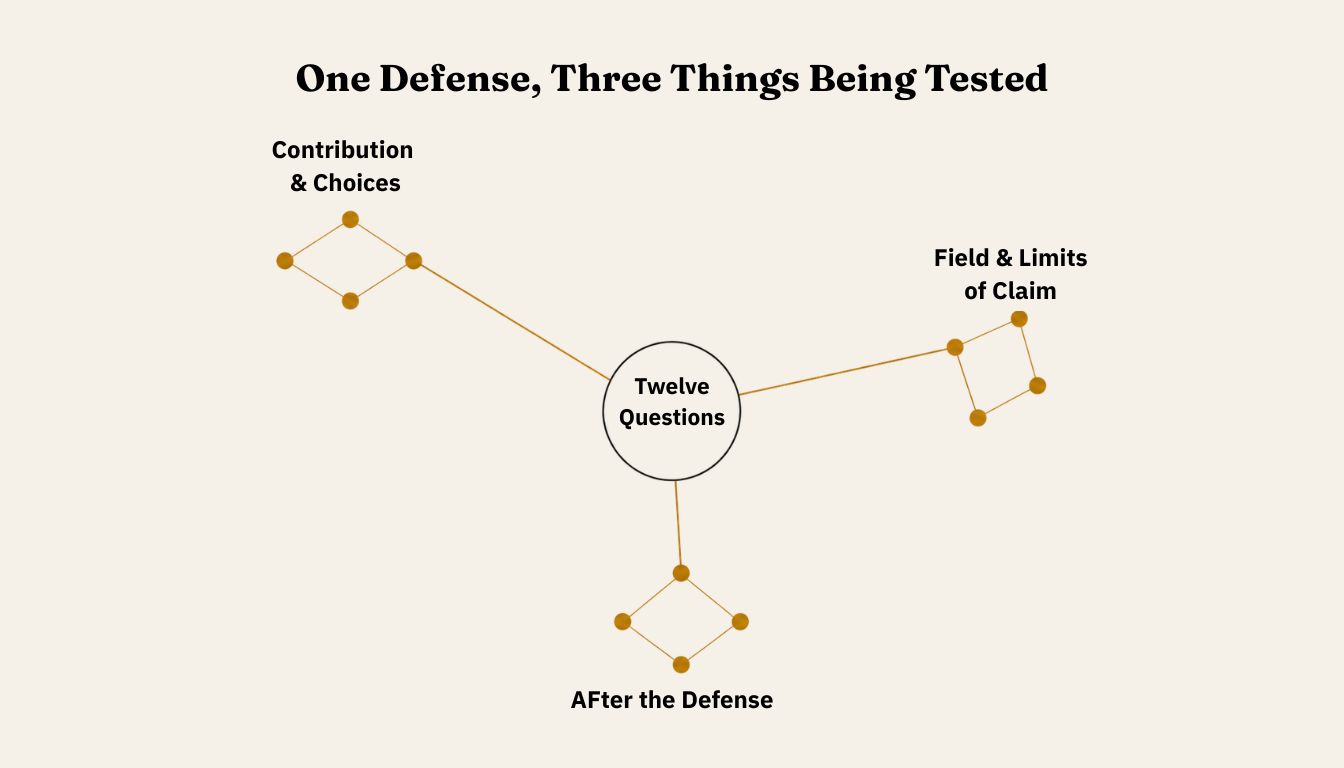
- The 12 dissertation defense questions fall into three groups: your contribution and choices, the limits of your claim, and what comes next. Committees in every field draw from the same pool.
- Freezing is usually a retrieval problem, not a knowledge problem. Candidates who know their work cold still stall when asked to say one specific thing out loud.
- Name your limits precisely. "This applies to first-generation students at large public universities" reads as rigor. "Every study has limitations" reads as evasion.
- Write a one-sentence answer to each question, then say it out loud to another person.
Dissertation defense questions vary by field. But committees test the same three things: whether you understand your work, where its limits are, and where it goes next. That's why the same twelve questions come up in almost every defense. You can prepare for them instead of the whole dissertation.
Knowing the material isn't the hard part. You can probably talk about your dissertation or thesis for an hour without notes. The hard part is answering when a committee member asks for one specific thing, said one specific way, on the spot. A defense tests what you can pull out of your head while someone waits. That's a different skill from knowing it.
Why the same questions keep showing up
The committee has read your dissertation before you walk in. Programs build this in. At UNC Chapel Hill's Genetics and Molecular Biology program, committee members are expected to read and evaluate the dissertation, then give the student written feedback. The university's graduate school holds the defense only after every member has had time to review a draft. Members also prepare questions about the research, the dissertation, and the field. So the questions don't re-check what the pages say. They test the decisions behind them.
Every dissertation follows the same arc. It names a problem, makes choices to address it, reports what those choices produced, and admits what is still open. Committees question each of those joints. Topics change. The joints don't.
The joints stay the same from field to field. What changes is which one gets pressed hardest. In many STEM defenses, that is the method: your sample size, your instruments, and why you chose this test and not another. In many humanities and qualitative defenses, it is the framing: why you chose this lens, and what it lets you count as evidence. The next section shows how to weight your preparation to match.
How the questions shift by field
Dissertation defense questions differ by field in what counts as a good answer, not in what gets asked. Every committee still asks about your contribution, your method, and your limits. Each field defines those words differently.
In STEM and quantitative fields, a strong answer is measured in evidence. Contribution means a new result, model, or measurement. Method questions turn on validity, controls, and why you chose one statistical test over another. Limits usually mean sample size, measurement error, and how far the findings generalize. Committees in these fields tend to check technical correctness closely.
In the humanities, a strong answer is measured in argument. Contribution means a new interpretation, or a change in how a body of work is read. Method questions turn on your lens and your sources: why this framework, and why these texts, archives, or cases. Limits often mean the boundary of your evidence and what your argument does not claim.
Contribution often means building or refining theory. Method questions turn on rigor: how you coded your data, how you accounted for your own position as the researcher, and how you know your account is trustworthy. Limits are usually framed as transferability, meaning how far the findings carry to other settings, rather than statistical generalization.
None of this is a rule, because committees vary by the people on them. If your work is interdisciplinary or your committee is split across departments, prepare for both kinds of answer. If your field isn't listed here, such as a professional doctorate, ask your chair which standard your committee applies.
Your contribution and your choices
These four questions come up in nearly every defense I've sat in on, because they separate "did the work" from "understands the work."
- What is your contribution, in one sentence?
- Why this method, and not an alternative?
- What would you do differently if you started again?
- What's the weakest part of your argument?
Knowing the answers isn't the same as being able to deliver them under pressure. That gap is where defenses go wrong, and a well-known study in Psychological Science shows why: on delayed tests, students who practiced recalling material remembered substantially more than students who simply reread it.
Why knowing it isn't enough
"It was right there." One student I worked with had presented their statistical approach a dozen times in practice. At the defense, a committee member asked them to explain it. The slide was already on the screen.
They stared at it and couldn't find the words. The answer was right in front of them, and they still couldn't say it.
I warned a Master's student before his proposal defense: "The committee will ask about your research gap. Be ready to explain it in one clear sentence." We rehearsed it. He said, "I've got this."
Then the committee asked, "Where exactly is the research gap in your study?" He talked about methodology, sample size and timeline, everything except the gap. They pressed him three times. Afterward he messaged me: "I practiced it. It just didn't come out."
Neither had a knowledge problem. They had a retrieval problem: they had practiced knowing the answer, not saying it under pressure.
How to answer each one
- Q1 (contribution): Use this formula: "I show that [finding] by [method], which matters because [gap]." Say it out loud until it takes ten seconds.
- Q2 (method): Name one alternative, one reason you rejected it, and one trade-off you accepted. For a worked example, see how to justify your research methodology.
- Q3 (do differently): Choose a real limitation, not a humblebrag, and say what you learned from it.
- Q4 (weakest point): Name it before they do. It shows you've stress-tested your own work.
Then rehearse with another person, out loud, with interruptions. Have them cut you off, ask "but why?", and stay silent for five seconds after you answer. A mock defense with a friend or labmate is the closest you'll get to the real room.
Your committee doesn't need you to be brilliant. They need you to be clear.Questions 5–8 of 12
The field and the limits of your claim
Once your contribution and choices are settled, committees turn outward. They want to see whether you can place your work honestly against everyone else's.
- How does this connect to [a paper the committee assumes you've read]?
- What are the limits of your sample or scope?
- Who is this work actually for?
- What surprised you during the research?
"Who is this for?" is really two questions
Committees sometimes fold two questions into one: what your work contributes to the field (academic) and what someone could actually do with your findings (practical). Answer both, not just whichever comes to mind first. The Southern University graduate school's list of common defense questions keeps them apart: one question asks about your contribution to your profession or society, and another asks which findings can be taken into practice.
"What are the limits of your sample?" is a rigor test
Most candidates under-prepare this one, because it's tempting to treat scope limitations as a weakness to minimize. A precise answer reads as rigor. For example: "This applies to first-generation undergraduates at large public institutions. I can't speak to how it generalizes to selective private schools, because the enrollment patterns differ enough that the mechanism I'm describing may not hold." A vague answer like "well, every study has limitations" reads as evasion, even though it's true.
The committee already knows your study has limits. What they're checking is whether you know exactly where they are.
How to answer the other two
- Q5 (the paper): Prepare a two-part answer: where your work agrees with that paper and where it departs from it. If you haven't read it closely, say what you do know and how you'd engage with it, rather than bluffing.
- Q8 (the surprise): Choose something that changed how you understood the problem, and say what you did about it. "Nothing surprised me" sounds like you weren't paying attention.
Where the work goes next
The last four are forward-looking. They check whether you see the work as finished, or as one step in something ongoing.
- How do you respond to the obvious counterargument?
- What's the next study, if you kept going?
- Why does this matter outside academia?
- Is there anything you'd like to add?
The counter argument question
The move worth copying is to name the study that could be used against you before anyone else does. One client did this in their related-work section: they named a specific prior study and used its finding as the setup for the exact gap their own work addressed, instead of pretending the prior research didn't exist.
Spoken, it sounds like this: "[Author, Year] found [result], which would predict [the opposite of your finding]. My data differ because [reason], and here is what I would need to see to change my mind." Naming the counterargument yourself, on your own terms, reads very differently than having a committee member bring it up.
The next-study question
Another client's recommendations section didn't stop at "more research is needed." It named a specific hard-to-reach subgroup from the original study, proposed ethnographic interviews to understand that group's barriers, and pointed to one concrete follow-on study: a feasibility trial tailoring intervention delivery to that subgroup's needs.
The pattern is specific limitation, then specific method, then specific next study. It carries over to most fields, and it lets you answer this question in three sentences.
How to answer the other two
- Q11 (outside academia): Name one specific person or group, and one thing they would do differently because of your findings. "Society" is too vague to be believable.
- Q12 (anything to add): Treat it as a free closing statement, not a formality. Restate your contribution in one sentence, then add one point the committee didn't ask about.
How to rehearse an answer
Write a one-sentence answer to each of these twelve before you write a paragraph. If you can't compress it to one sentence, that's the part to work on — not the part to over-prepare with more words. The Master's student above had plenty to say about his research gap. What he hadn't tested was whether his one sentence would hold up under pressure.
Then say the sentence out loud, to another person, under mild time pressure. Reading an answer silently and defending it out loud under questions are two different skills — the student who froze on the statistics question wasn't unprepared on paper. He was unprepared out loud.
The night before
Don't reread the whole manuscript. Reread your one-sentence answers to these twelve questions, and get some sleep. Committees can tell the difference between someone who knows their work and someone who memorized their manuscript the night before — and it isn't the second one who does well.
If a question here catches you off guard because your chapters never quite connected to each other, that's usually an outline problem more than a memory problem, whether you're defending a dissertation or a thesis. See how dissertation chapters should set each other up.
FAQ
How long should my answer be to each defense question?
Aim for 30–60 seconds in the room, but rehearse the one-sentence version first. If you can't say it in one sentence in practice, you won't manage it live either.
What if I genuinely don't know the answer to a question in my defense?
Say so directly, then reason out loud toward an answer. "I hadn't considered that. My instinct is X, because Y" lands better than a confident guess.
Should I memorize my answers word-for-word?
No. Memorize the one-sentence core, not a script. Word-for-word answers fall apart under a follow-up question.
How is a Master's defense different from a PhD defense?
It's usually shorter, often 45-60 minutes against up to two hours for a PhD, and it focuses more on whether you can run a sound research process than on whether you're extending the field. The same twelve questions apply, with more weight on methods and less on original contribution.
What happens if the committee disagrees with each other in front of me?
It happens more often than prep guides admit, and it isn't a trap. Acknowledge both positions specifically, then answer, rather than siding with whoever spoke last or loudest.
Final thoughts
The twelve questions in this post cover your contribution and choices, your place in the field and the limits of your claim, and where the work goes next. Knowing the answers is not the same as being able to say them under pressure, so write a one-sentence answer to each, say it out loud to another person, and let them interrupt you. Your committee has already read your work. What they want to see is that you can explain it clearly.