
TL;DR
- A research gap is a specific, unanswered question — not just a topic nobody's covered.
- A gap can be original and still fail if it names no single text to closely analyze.
- Most topics fail on four things: overdone territory, weak argument, poor scope, or no named gap.
- Fix the scope first. It usually solves the other three on its own.
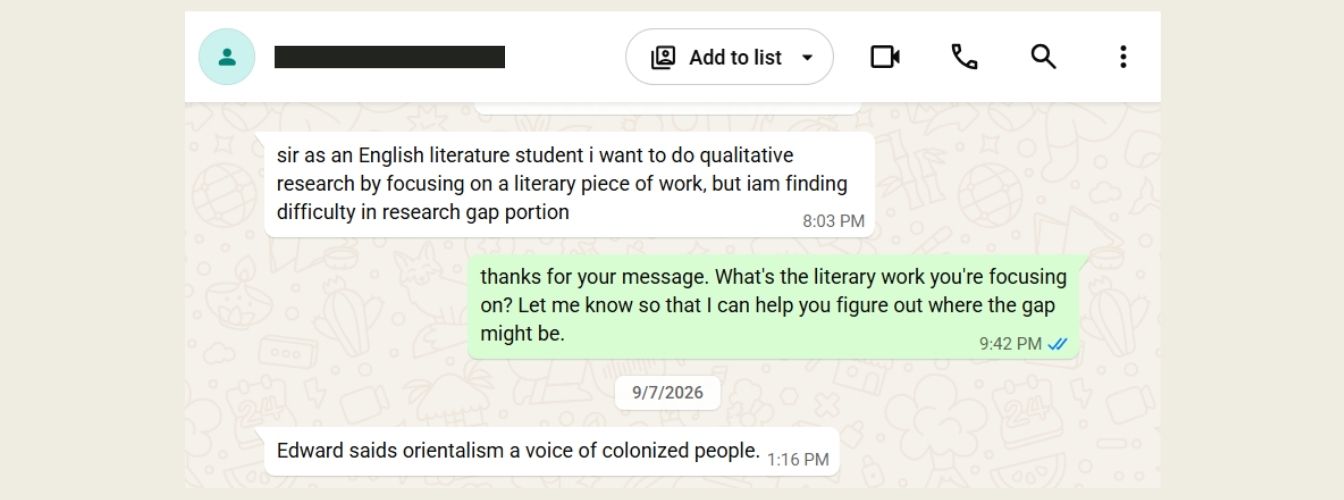
"Sir as an English literature student I want to do qualitative research by focusing on a literary piece of work, but I am finding difficulty in research gap portion." A student sent me that message on WhatsApp. I asked what literary work they were focusing on. They named Edward Said's Orientalism. They called it "a voice of colonized people."
We went through four title revisions. One version looked ready. It had a strong angle. It had a clean research question. I still flagged it. The idea wasn't weak. The title named no book. It named no author. It gave us nothing to close-read. The next fix wasn't a bigger idea. It was one novel. It was one character. It was one narrative device. We made it specific enough to argue with. That's usually what a research gap really is. Not a missing theory. A missing anchor.
Starting from the wrong place
The first message set the direction for everything after it:
“Edward said's orientalism a voice of the colonized people.”
This sounds reasonable. It's backwards. Orientalism isn't the colonized speaking. Said studies how the West talks about them. Gayatri Spivak built a whole argument around this exact irony. She asked a simple question: can the subaltern ever really speak, when sympathetic Western critics keep speaking for them instead? People still reach for her essay first. Said's book studies representation. It was never built to deliver a voice of its own.
I didn't correct the assumption and move on. I turned it into a question instead: does the novel give its colonized characters real voice, or does it stay trapped inside the same gaze Said describes? That question ended up sharper than the assumption it replaced. It became the seed the final topic grew from.
Theory or tool: the choice most students skip
One decision had to come first: is Orientalism the dissertation's subject, or its tool? Studying the book on its own terms is one project. Using it to read a novel is a different project. Most students skip this choice. They find out which paper they wrote after they've already written half of it.
The topic that had no gap at all
Not every idea fails for the same reason. This one failed for four, all at once.
Representation of the East as 'The Other' in Rudyard Kipling's Kim: A Postcolonial Study. Said analyzed Kim himself, so the ground is covered before anyone even starts. The title describes rather than argues — it states what the novel does and proposes nothing to investigate. It's too broad for a dissertation chapter, an entire novel and an entire theoretical field at once. And it names no gap, when a strong title usually signals what's missing from the start.
All four are worth naming, because the next version clears three of them and still doesn't work. Speaking Back to Orientalism: Reclaiming Agency and Identity in Contemporary South Asian English Literature had a real, original gap and a clean research question. It also named no single book anywhere in it.
What finally worked was smaller: Negotiating Orientalist Othering: Changez's Self-Representation and Narrative Authority in Mohsin Hamid's The Reluctant Fundamentalist. One character, one device, one novel a reader could actually go and check the argument against.
Why scope is the fix that actually matters
A title usually fails for one of four reasons: it's overdone territory, it's descriptive instead of argumentative, it's too broad for the word count, or it names no gap. These aren't equal weight. I don't treat them as four boxes to tick in any order. Narrow the scope first. The other three tend to resolve as a side effect. A narrower angle is automatically less-covered ground. Less-covered ground is where a gap usually turns up on its own.
An argumentative-sounding title doesn't fix any of this. It reads better. But if the scope stays broad, the paper still can't support the claim it's making. Naming the gap outright is the deepest fix of the four. It's also the hardest to do first — a gap is nearly impossible to see in a topic still trying to cover an entire novel. Overdone territory can't be fixed head-on at all. It clears on its own once the scope narrows.
| Problem | Fixable on its own? | What actually fixes it |
|---|---|---|
| Overdone territory | No | Clears once scope narrows |
| Descriptive, not argumentative | Partially | Cosmetic; doesn't solve scope |
| Too broad for the word count | Yes | The root fix — narrow this first |
| No gap named in the title | No | Only visible once scope is narrow |
This is what a proper literature review is built to expose. Narrower reading turns up the thin, under-covered spots a broad topic hide. That's why I tell students not to pick a title before that reading is done.
The draft that looked done and wasn't
“Speaking Back to Orientalism: Reclaiming Agency and Identity in Contemporary South Asian English Literature.”
Main research question: How do contemporary South Asian English-language writers challenge Orientalist representations of identity, culture, and history?
This is the draft this post is named after. On a first read, it looks solved. The gap is genuinely original — flipping "how the West represents the East" into "how the East represents itself" is a real inversion of Said, not a restatement of him. The research question reads clean.
Then you look for the book. "Contemporary South Asian English-language writers" names no author, no title. That's a thesis-scale claim being asked to fit into a dissertation chapter, and there's nothing in it to actually close-read.
This draft passed the interesting one while failing the one that determines whether the project is even possible to write.
The next fix wasn't a new idea — it was picking one writer and one book to carry it. Not because the bigger claim was wrong, but because a claim that size needs a whole field of scholarship behind it, not one dissertation chapter.
From applying a theory to arguing something
The next draft fixed the scope problem. It picked a single novel and a single theory instead of an entire field. But naming a theory to apply isn't the same as taking a position on it, and that gap shows up before the reader even finishes the title.
“Applying Edward Said's Orientalism to Contemporary South Asian Literature: A Postcolonial Analysis of Mohsin Hamid's The Reluctant Fundamentalist.”
Real progress — one novel, one theory, a defined space to work in. But "applying" gives away the remaining problem before the reader gets past the title. Applying a theory is a method, not a claim. It tells a committee what steps will be followed, not what the writer is willing to argue. What was missing wasn't a better theory. It was a stance — does the novel confirm Said's framework, complicate it, or break somewhere he never accounted for.
"Negotiating Orientalist Othering: Changez's Self-Representation and Narrative Authority in Mohsin Hamid's The Reluctant Fundamentalist".
Two things changed. The scope dropped from the whole novel to one character and one device. And the gap went formal instead of thematic — not another paper about identity in the novel's content, but a question about what the narration itself is doing while it talks.
That angle only works because of how this specific novel is built: it's a one-sided monologue, and Changez controls everything the listener hears. Narrative authority isn't a lens applied from outside here. It's the book's actual structure, which is what makes the argument defensible rather than decorative.
What the last round of notes actually looked like
By the final round, there was nothing left to argue about. The title held. The scope held. The gap was formal, specific, and already tied to the novel's actual structure. What was left wasn't a rethink — it was one grammar fix: "Changez's negotiate" needed to become "Changez negotiate."
Those notes were structural. They narrowed the scope, named the gap, and picked a stance. That's not just what a strong dissertation topic needs — it's also what a research proposal has to demonstrate before a committee will approve it. This one didn't touch the argument at all. No theoretical breakthrough in that exchange. Just clean-up — which is exactly what a last round of notes should look like once the real work is already done".
FAQ
What is a research gap in literature?
A specific, unanswered question in existing scholarship — not just an under-covered subject.
Why does a topic with a real gap still get rejected?
Most research gaps get rejected because originality and workable scope are separate tests, and a topic can pass one while failing the other.
How much scope actually fits in a dissertation chapter?
One text, one angle — a character, a device, a specific tension, not a body of work or a movement.
Can Orientalism be used as a theoretical framework?
Yes, either as the primary text itself or as a lens on a separate literary work — decide which before writing the proposal.
Does it matter if the text's already been written about?
Only if your specific angle has too. A canonical text can still yield a gap through an under-examined character or device.
What are the types of research gaps?
The most common types are: a topic that hasn't been studied much, existing studies that disagree with each other, a gap in a specific population or setting, and a gap in the methods used so far.
What's the difference between a research gap and a research question?
A research gap is the missing or unresolved piece in existing research. A research question is what you ask in order to fill that gap — the gap is the problem, the question is your way of tackling it.
Final Thoughts
The third draft wasn't close — it just looked closely, and that gap is the whole lesson here. A clean question and a real research gap will always read as finished before you've checked whether there's one specific text underneath it to argue with. Check scope last, and drafts like that one will keep fooling you the same way. Check it first, and most of what looks like a stuck research gap turns out to be a scope problem wearing a theory costume. If your own gap is close to settled and you're starting to map out what comes next, it's worth looking at how long the writing itself actually takes once the thinking is done — word count is rarely the part that decides your timeline.