


TL;DR
- ABD ("All But Dissertation") isn't a real degree — it's the stage between finishing coursework/exams and completing the dissertation.
- About half of ABD candidates never finish, and completion rates vary widely by field, from 42% in history to 64% in engineering.
- Most programs cap candidacy at five to eight years, after which candidates may need to retake exams, petition, or reapply.
- Funding gaps and lost structure after coursework ends are the biggest reasons candidates stall out.
- Candidates who finish treat the dissertation like a job — fixed hours, small milestones, and an early personal deadline.
Every graduate program has ghost stories. In doctoral circles, the best-known one is about students who vanish into the dissertation phase and never return. They finish coursework. They pass exams. They clear every hurdle official records track. Then the finish line never comes. People just call it "ABD." So, what is an ABD degree? It isn't a degree at all. It's a holding pattern. Universities rarely publish the real dropout numbers. And it swallows far more doctoral candidates than outsiders ever realize.
What Does ABD Actually Mean?
The ABD meaning is straightforward on paper: All But Dissertation. It refers to a doctoral student who has completed coursework, passed comprehensive or qualifying exams, and often had a dissertation proposal approved by a faculty committee. The only thing standing between that student and a PhD is the dissertation itself — the research, the writing, and the defense.
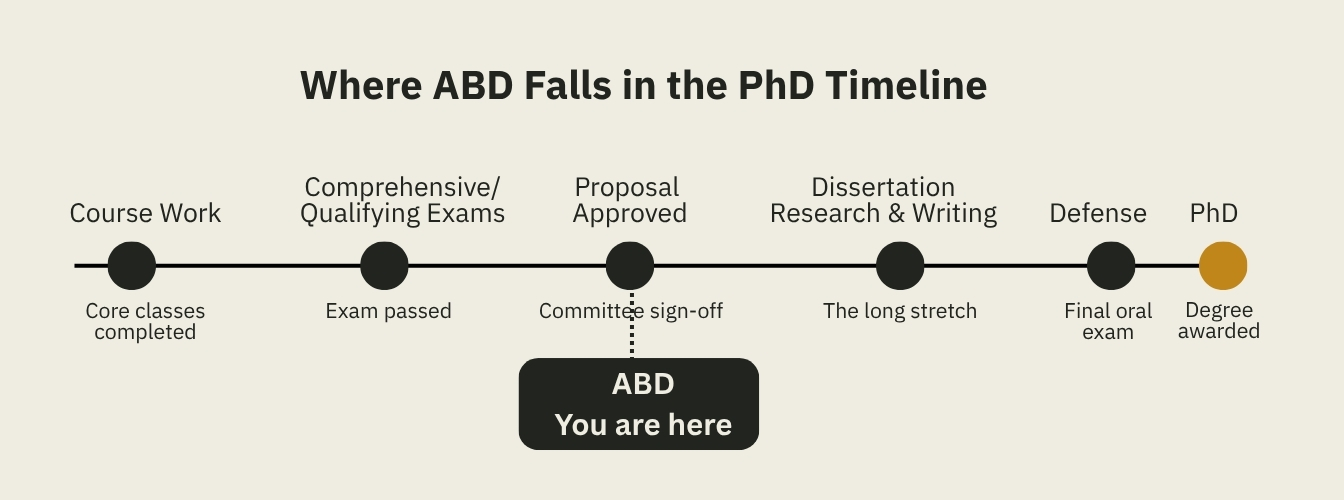
Despite how often the term gets used, it isn't an official designation. It functions as academic shorthand among graduate students and faculty, not a formal title. This isn't a modern phenomenon caused by burnout culture or overextended graduate students; it's a structural feature of how research doctorates have worked for decades.
It's a Stage, Not a Credential
People search for what is an abd degree expecting to find some kind of consolation prize or intermediate certificate, and it simply doesn't exist in most programs.
No university mails out a diploma for reaching this stage. It won't show up as a line item on an official transcript.
It's a description that faculty, students, and administrators use informally to describe where someone stands, similar to saying a house is "under contract" rather than sold.
A few institutions have created something closer to formal recognition. The University of Wisconsin–Madison, for instance, offers a Certificate of Doctoral Candidacy for students who complete every requirement except the dissertation but don't plan to finish.
Why Do So Many ABD Candidates Never Finish?
Admissions tours rarely mention this part. Attrition among ABD candidates is commonly estimated at around 50 percent, meaning roughly half of doctoral students who reach this stage never actually finish. That figure alone reframes the entire conversation. Reaching this stage isn't a guarantee of eventually earning a PhD; for a huge share of students, it turns out to be as far as the process goes.
Nationally, attrition across PhD programs generally lands somewhere between 50 and 60 percent. The Council of Graduate Schools' long-running PhD. Completion Project remains one of the most extensive efforts ever undertaken to track why doctoral students leave before finishing.
Completion rates vary sharply by field. The table below breaks down where students are most — and least — likely to finish:
| Field | 10-Year Completion Rate | Median Years to Complete |
|---|---|---|
| Engineering | 64% | 5.3 |
| Life sciences | 63% | 5.7 |
| Math & physical sciences | 55% | 5.5 |
| Social sciences | 56% | 6.0 |
| Humanities | 49% | 6.8 |
| History specifically | 42% | — |
A student entering a history PhD program between 1996 and 2005 was, statistically, more likely to leave without the degree than to finish with one. For anyone trying to avoid becoming part of that number, the 45-minute rule is one practical way dissertation-phase candidates rebuild momentum without burning out.
Why the Dropout Curve Looks the Way It Does
Attrition doesn't happen evenly across a program's timeline. A quarter of students who entered PhD programs in the mid-1990s had already left by their fifth year, and more than two-thirds of eventual dropouts had exited by the end of year four. That timing matters. Most of the loss happens right around when coursework wraps up and the open-ended dissertation phase begins — precisely the point where this stage kicks in.
What Makes the Dissertation Stage So Hard?
None of this comes down to ability. Plenty of people who stall out at this stage were strong students who handled years of coursework and gruelling exams without issue. What derails them in the dissertation phase is structural, not personal.
The Practical Pressures
Funding is usually front-loaded toward coursework years, when a student is teaching or assisting with research. Once that structure ends, support often tapers off right when a candidate needs long, uninterrupted time to write — so many end up juggling part-time or full-time work alongside a dissertation that assumes something closer to full attention.
Life doesn't pause to accommodate the gap either. Marriages, kids, aging parents, and job offers all compete for the same hours, and without a weekly deadline forcing progress, it's easy for the dissertation to quietly lose the fight.
The dissertation is the only thing in a PhD program with no fixed deadline — which means it's the only thing that can always wait one more week.
The Human Factors
Advisors don't always show up when it matters. Some go quiet for months, leaving drafts unread; others micromanage every paragraph until a student dread submitting new work.
Either way, the steady feedback loops a dissertation needs never materializes. That absence compounds with isolation — coursework's built-in community of classmates and shared deadlines disappears entirely, leaving the work solitary and largely invisible outside a small advising committee. Without visible progress or steady support, confidence erodes fast: a single rough committee meeting can turn into months of avoidance when there's no clear finish line pulling a candidate back to the desk.
How Long Can Someone Actually Stay ABD?
There's no universal answer. Most programs set a ceiling anyway — usually five to eight years from the day a student first enrolled. Once that window closes, the consequences depend on the institution. Some require candidates to retake comprehensive exams. Others require a formal petition. In the more unforgiving cases, a lapsed candidate has to reapply to the program from scratch.
The clock rarely stops just because writing slows down, either. Most universities require continuous enrollment during the dissertation phase, which usually means paying reduced tuition or fees every semester just to remain an active candidate — whether or not real progress is happening.
Timelines also shift by field. Lab-based sciences often move faster since data collection has a natural endpoint, while humanities and archival-heavy disciplines can stretch longer simply because the research itself takes more time to gather before writing even starts. This is part of why the abd meaning shifts slightly depending on who's explaining it — a five-year ABD in engineering and an eight-year ABD in history describe very different situations.
ABD status is easy to lose track of because there are no deadlines forcing the issue. Coursework had them. Exams had them. The all but dissertation phase doesn't. "I'll pick this back up next semester" can repeat for years before anyone notices — including the candidate. Most people underestimate how long dissertation writing actually takes long before they ever hit an institutional deadline.
What Happens to People Who Never Finish?
Not every unfinished dissertation ends in nothing. Many programs award a master's degree on the way out. Coursework alone often clears that requirement.
What happens next depends on which door someone walks through. Academic hiring committees usually draw a hard line. A completed doctorate is the price of entry. There are no exceptions for getting close. Outside academia, the math changes. Consulting firms, research labs, and university administration offices often value skills over a finished dissertation. Many people search what is an abd only after leaving one behind, once they need to explain the gap on a resume. The training itself doesn't disappear. Plenty of hiring managers know it.
How ABD Candidates Actually Break Through
The candidates who finish tend to do a few specific things differently. They set fixed working hours for the dissertation, the same way they would for a job, instead of waiting for motivation to strike. They break the dissertation into small pieces with real deadlines — a literature review chapter due this month, a data chapter due next month — instead of treating the whole project as one unmanageable task.
They also keep their advisor involved on a schedule, not just when there's a draft ready to show. A monthly meeting, even with nothing finished yet, keeps the project moving instead of stalling in private.
Many join a writing group or connect with other candidates stuck at the same stage — proof that the abd meaning isn't just academic jargon, it's a shared, lived experience for thousands of people at once. And most set their own deadline months before the university's official cutoff, so there's still time to fix problems instead of running out the clock.
FAQ
Is ABD the same thing as being a "doctoral candidate"?
Mostly, yes — the two terms usually describe the same stage, though "doctoral candidate" is the more formal, official phrasing a university is likely to use, while "ABD" is the shorthand people actually use in conversation.
Can someone list ABD after their name, like a credential?
It's common in academic and professional bios, especially on a CV, but it's understood as a description of progress rather than a credential with the same weight as an earned degree.
What's the difference between ABD and ABT (All But Thesis)?
They describe the same basic situation, just in programs that use "thesis" instead of "dissertation" as the terminology for the final research project — largely a difference in vocabulary rather than substance.
Does ABD status ever expire and reset silently?
Not silently — programs that impose time limits typically require a formal process, like a petition or reapplication, once a candidate passes the cutoff, rather than automatically dropping someone without notice.
Final Thoughts
What is an abd degree, in the end? Not a milestone. A fork in the road. Roughly half the people who reach it take the wrong path, and most never actually decide to. It happens one postponed semester at a time, one quiet advisor silence at a time, until years have passed and the dissertation is still exactly where it was. The candidates who cross the finish line aren't smarter or more talented than the ones who don't. They just refused to let the absence of a deadline become an excuse for one. That's the difference between finishing and disappearing into the ABD label for good.