

TL;DR
- Write it last — after the dissertation is done, not before.
- Order: supervisor and committee, then funders, then colleagues and support staff, then family.
- Length: half a page to a page. Check your program's cap before assuming you have room.
- Specific beats generic — name the actual thing they did, not a trait.
Dissertation acknowledgements are usually half a page to one full page, placed after the title page and before the abstract or table of contents. They thank your advisor, committee, funders, and personal supporters, in that order, and are written in a warmer, more personal tone than the rest of the dissertation.
Order matters more than most writers realize. Writing your acknowledgements before finishing a single chapter seems harmless — it isn't. You thank people for work that isn't done, crediting help whose real weight you won't know until the dissertation is finished. Then there's the other trap: treating this page like it doesn't matter (four lines, ten minutes, done) or treating it like your diary (longer than the actual introduction). Both miss the point.
Dissertation programs follow specific rules on order and length. Once you know them, all three problems above go away.
What actually goes in a dissertation acknowledgements section?
Acknowledgements contain professional tributes — specific thanks, with a reason attached, for people who helped you develop the work. It's easy to confuse with two nearby sections:
| Section | What it says | Style |
|---|---|---|
| Dedication | Who it’s for — no reason given | One line (“To my parents”) |
| Preface | Why you got interested in the topic | Personal, origin-story style |
| Acknowledgements | Who helped, and what they specifically did | Professional tribute + reason |
Here's what that looks like in practice:
University of Michigan-Dearborn's dissertation formatting guide shows the standard: "I would like to thank my thesis advisor for his hours of help in the lab, ensuring that experiments were set up correctly, and guiding me through the thesis process."There's one more rule worth knowing: if a chapter reuses previously published material — a journal article you co-authored, later turned into a chapter — UC Irvine's formatting manual requires you to acknowledge this and list the co-authors here. Check your own program's manual for exact wording.
Authorship or partnership disputes, funding mentions buried inside personal thank-yous instead of their own paragraph, or anything that reads as an argument rather than gratitude.
If you've had a strained relationship with a supervisor or committee member, this isn't the place to raise it — stay honest, stay professional, and move on.
Why “write it last” is the rule — and when it isn't
You're describing help that already happened, in specific terms — which means it has to be written after the fact, not before. If you don't know how long that will take, it's worth checking how long it typically takes to write a dissertation before you plan around it.
Write it too soon, and you'll either thank someone before they've actually done anything, or leave out whoever helps last.
A colleague who covers your teaching duties during the final stretch, or a friend who reviews your discussion chapter at 11:30 p.m. three days before the deadline.
That kind of help tends to show up late, which is exactly why the page waits until the end.
The one exception: some students write a rough version of this page before Chapter 1, not to thank anyone yet, but to remind themselves who they're doing the work for. When the dissertation is done, it gets rewritten from scratch, this time as actual thanks for actual help.
This early version doesn't replace the real acknowledgements page you'll submit — it's just there to help you start writing.
If you're struggling to start writing and keep drifting toward a thank-you page instead of an outline, that's usually a sign to start with an outline first — see my chapter outline guide.
Who do you actually thank, and in what order?
Style guides don't agree on the exact order — but the sequence that reads most naturally to a committee moves from formal to personal:
| Order | Who | What belongs here |
|---|---|---|
| 1 | Supervisor & committee | Almost always the longest paragraph. Name the type of guidance, not just “guidance.” |
| 2 | Funders & institutions | Its own paragraph if you had a grant or departmental funding. Number it if necessary. |
| 3 | Colleagues & support staff | Librarians, lab staff, anyone who helped collect data — the most forgotten group. |
| 4 | Family & friends | Personal, informal, last. Usually the first-person paragraph in the paper. |
Starting formal and ending personal isn't just convention — it mirrors how a reader expects a professional document to close: institutional obligations first, personal gratitude last. Flip that order, and the section reads oddly, even if every name in it is correct.
Check your program's manual before finalizing — some departments require this exact sequence, others limit the section to professional thanks only and leave family out entirely.
If your program gives no guidance, formal-to-personal is the safest default — it's the order least likely to look out of place to a committee.
Here's what that looks like in a real acknowledgements section (names redacted):
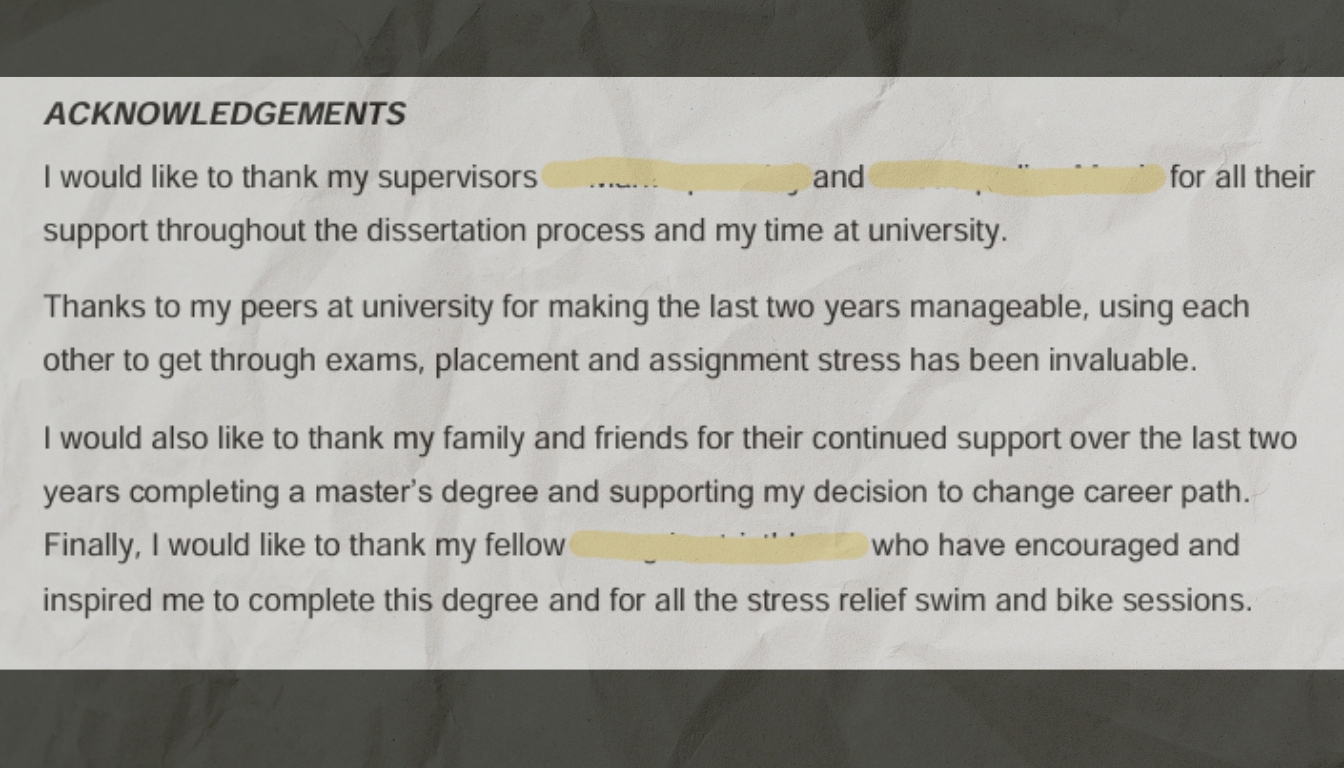
This student skipped the funders paragraph — not every dissertation has one — but kept the rest of the order intact. The supervisors come first. Then peers, credited for something specific: getting each other through exams and placement stress, not just generic "support." Family comes last, tied to something concrete — a career change, not a vague thank-you — and the closing line names an actual detail ("stress relief swim and bike sessions") instead of padding out the paragraph.
How long should it actually be?
Acknowledgements typically run half a page to a page. That's a norm, not a hard rule — some programs cap it, so check your manual before assuming you have room.
Length isn't really the goal, though — specificity is. Four sentences that name exactly what someone did will read better than two vague pages, and padding shows immediately once a reader hits it.
| Section | Typical length |
|---|---|
| Supervisor & committee | 2-4 sentences |
| Funders (if applicable) | 1-2 sentences |
| Colleagues & support staff | 2-3 sentences |
| Family & friends | 2-4 sentences |
Add those up and most acknowledgements land around half a page total — closer to a full page only if your funding or support network was unusually large.
If you're unsure whether yours runs long, read it aloud. Extra words are obvious the moment you hear them — far more obvious than when you're silently reading your own writing back.
What makes a real line actually work
Here's an actual line from a dissertation:
Thanks to the prayers of my parents and the constant guidance of my supervisor, I was able to successfully complete this thesis.
This beats the usual generic paragraph for one reason: it names exactly what each person did. Not "support" — prayers. Not "guidance" — constant guidance. That single word, "constant," is what makes the supervisor's contribution feel specific instead of interchangeable.
| Generic version | Specific version |
|---|---|
| “...for his support and guidance throughout this process.” | “...for his constant guidance throughout this process.” |
| “Thank you to everyone who supported me.” | “My parents' prayers... allowed me to complete this dissertation.” |
The left column could sit in any dissertation, about any supervisor, in any field. The right column can't — it names a real relationship, described plainly, with no embellishment.
If a sentence in your acknowledgements could be copied verbatim into someone else's dissertation, it isn't finished yet.
That's the actual test — not word count. When a sentence fails it, the fix isn't a stronger adjective. It's one more concrete detail about what actually happened.
Where the list actually comes from
Don't start this section with a blank page. Start by working backward through your own methods and results chapters.
Go chapter by chapter and note who's named or required there: the supervisor who redirected a weak argument, the librarian who tracked down an obscure source, the funder listed on your title page.
By the time you've done that, you usually have your full list — before writing a single sentence of acknowledgements. It's more reliable than trying to remember everyone from scratch afterward.
What Are the Most Common Acknowledgements Mistakes?
A quick reference for patterns that often appear in early drafts — before anyone else reads them:
| Mistake | Why it fails |
|---|---|
| Generic phrasing | “Thank you to everyone who supported me” says nothing about what someone did. |
| Wrong order | Mentioning your family before your supervisor can quickly read as too informal. |
| Forgetting funders | Most graduate schools require a financial acknowledgement, not just a personal thank you. |
| Ignoring program rules | Some departments limit the length or tone of your acknowledgements — check before you write, not after. |
What Should You Check Before You Submit It?
- Is your supervisor thanked first, and specifically — for what kind of guidance, not just “guidance”?
- If you had a grant or institutional funding, is it in its own paragraph, with the grant number if necessary?
- Have you checked your program manual for length caps, rather than assuming half a page is safe?
- Does every sentence pass the swap test — can it be pasted into someone else's paper without change?
- Have you read it through once, just as your committee would?
If you're still deciding where to include the ‘acknowledgements’ in your overall structure, the chapter outline map covers this aspect as well.
FAQ
Where do acknowledgements go in a dissertation?
Near the front — after the title page, before or with the abstract, ahead of the table of contents. Confirm the correct location against your program manual, as it varies by institution.
When should you write your dissertation acknowledgements?
Almost always last, once the dissertation is finished, so you are thanking people for what actually happened rather than what you expected. Writing an initial draft as a motivational anchor is a real exception — it should be rewritten faithfully once the work is complete.
How long should the acknowledgements section of a dissertation be?
Usually, half a page to a full page. Some programs set an explicit cap, so check your formatting manual before assuming you have unlimited room.
Do I have to acknowledge my funding source?
If you've received grants or institutional funding, yes — usually in its own paragraph, separate from a personal thank you, sometimes with the grant number.
Can dissertation acknowledgements be informal?
Yes — it's one of the few sections where first-person, conversational language is expected rather than tolerated, as long as the tone stays appropriate for an academic document.
Final Thoughts
An acknowledgements section isn't judged on length or sentiment. It's judged on specificity. The real dissertation line — “my parents' prayers and my supervisor's constant guidance” — works because it names what actually happened, not because it's warm. Generic gratitude reads the same in every dissertation. Specific gratitude only fits one. Write it last, follow the order your committee expects, and say what each person actually did. That's the whole job.